
 |
 |
 |
 |
 |
 |
 |
 |
 |

 |

Kyoto, Japan (SPX) Oct 13, 2010 Knowing how to build nanosized assemblies of polymers (long molecular chains) holds the key to improving a broad range of industrial processes, from the production of nanofibers, filters, and new materials to the manufacture of low-energy, nanoscale circuits and devices. A recent paper in Nature Communications sheds light on key behaviors of polymers in specially engineered confined spaces, opening the door to a level of control that has previously been impossible. Scientists in Japan at Kyoto University and Nagoya University have succeeded in manufacturing custom-designed sub-nanometer scale channels, or pores, which can be manipulated to trap polymers and allow researchers to observe how these chains respond to temperature changes. Previously this level of observation was not possible, and hence much about polymer behaviors in subnanometer spaces - in particular thermal transitions - was unknown. The technique uses specially designed substances known as porous coordination polymers (PCPs), which are notable for the high-degree to which their pore sizes and other characteristics can be controlled. "PCPs allow us to design cages in which to trap specific molecules," explains lead scientist Dr. Takashi Uemura of Kyoto University's Graduate School of Engineering. "In this case, polyethylene glycol molecules - PEGs - can be accommodated in the cages similarly to the way in which sea eels hide in holes. In open water there is no order to their swimming. But in cylindrical pipes, they prefer to arrange themselves linearly in groups. Polymer chains do this as well, becoming orderly assembled in the PCP channels." In this case, the PCP channels were precisely tuned to control their size and inner surface characteristics, allowing the research team to directly observe how the polymers behaved. This led to the unexpected finding that the transition temperature - in this case, melting point - of confined PEGs decreased as their molecular weight - length in this instance - increased. "This was exactly the opposite of what we had observed in bulk, that is, 'free' PEG," elaborates Dr. Susumu Kitagawa, deputy director of Kyoto University's Institute for Integrated Cell-Material Sciences (iCeMS). "We believe this to be the result of destabilization of the PEG chains under confinement. Instability increases together with chain length." Understanding such minute details of the behaviors of nanoconfined polymers gives rise to the possibility of future breakthroughs in nanoscale manufacturing based on assemblies of small numbers of polymer chains, which may in turn be used to fabricate a wide range of new materials. The article, "Unveiling thermal transitions of polymers in subnanometre pores" by Takashi Uemura, Nobuhiro Yanai, Satoshi Watanabe, Hideki Tanaka, Ryohei Numaguchi, Minoru T. Miyahara, Yusuke Ohta, Masataka Nagaoka, and Susumu Kitagawa, appears in the October 5, 2010 issue of Nature Communications.
Share This Article With Planet Earth
Related Links Institute for Integrated Cell-Material Sciences, Kyoto University Space Technology News - Applications and Research

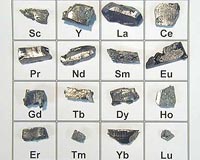 Japan seeks solutions for rare earth curb
Tokyo (UPI) Oct 7, 2010 Japan aims to curb its reliance on China for rare earth minerals particularly after China abruptly halted mineral shipments to Japan in recent weeks due to a diplomatic dispute between the countries. Rare earth elements are indispensable to a range of green energy and high-tech components such as wind turbines, low-energy light bulbs, batteries for hybrid and electric cars, lasers, fibe ... read more |
|
|
| The content herein, unless otherwise known to be public domain, are Copyright 1995-2010 - SpaceDaily. AFP and UPI Wire Stories are copyright Agence France-Presse and United Press International. ESA Portal Reports are copyright European Space Agency. All NASA sourced material is public domain. Additional copyrights may apply in whole or part to other bona fide parties. Advertising does not imply endorsement,agreement or approval of any opinions, statements or information provided by SpaceDaily on any Web page published or hosted by SpaceDaily. Privacy Statement |


 del.icio.us
 Digg
Digg Reddit
 YahooMyWeb
 Google
 Facebook


