
 |
 |
 |
 |
 |
 |
 |
 |
 |

 |

West Lafayette IN (SPX) Sep 15, 2010 After heavy rains and winds from Hurricane Earl pummeled their operations base in St. Croix, Virgin Islands, three Purdue University students continue to collect data as part of a team flying over the tropical Atlantic Ocean to take measurements of what might develop into tropical storm Gaston. Graduate students Alexandria Johnson, Brian Murphy and Paytsar Muradyan are part of a National Science Foundation-funded project to better understand the conditions that promote or hinder hurricane formation and provide earlier warnings to those in harm's way. The project, Pre-Depression Investigation of Cloud Systems in the Tropics, will run until Sept. 30. The students are working with Jennifer Haase, the assistant professor of earth and atmospheric sciences who leads the Purdue experiment, and James Garrison, a professor of aeronautics and astronautics. "Often hurricanes originate in storm systems that develop off the west coast of Africa, but it is very difficult to predict which storm systems will develop into a hurricane and which will produce thunderstorms and then dissipate," Haase said. "We are flying into these areas to make measurements and try to figure out what conditions lead to the development of a hurricane." The Purdue researchers are studying the moisture-uptake process to find early characteristics that drive a storm to eventually form a hurricane. The team developed the GPS Instrument System for Multistatic and Occultation Sensing (GISMOS) to measure satellite signals as they travel through the atmosphere. The signals' speed varies depending on atmospheric conditions, and, through small signal delays, the team can determine the amount of water vapor in the atmosphere. "If the moistening process is understood, then we may be able to identify which storm systems are the most critical to track and improve forecasting," Haase said. "We hope to make it possible to forecast hurricanes further in advance, for example five days rather than the current two or three." The scientists hope that results from the project will eventually be able to give people more time to prepare or evacuate to save lives and reduce the destruction when a hurricane makes landfall. The instrument has been installed on a Gulfstream V research aircraft owned by the NSF and run by the National Center for Atmospheric Research. The jet can reach an altitude of about 43,000 feet, enabling scientists to take observations near the tops of storms that form thousands of miles off the coast. If the Purdue experiment is a success, the instrument could be installed on hurricane research planes to feed information to forecasters or eventually on commercial airlines to collect data during routine flights, Haase said. The results also could be applied to future use of satellites that gather similar information, however, there are not currently enough satellites to be able to provide data in good locations for hurricane forecasts. In addition to Purdue, collaborators include the National Center for Atmospheric Research, the Naval Postgraduate School, University at Albany-SUNY, University of Illinois at Urbana-Champaign, University of Miami, NorthWest Research Associates Inc, New Mexico Institute of Mining and Technology, and University of Wisconsin-Madison.
Share This Article With Planet Earth
Related Links Purdue Department of Earth and Atmospheric Sciences Bringing Order To A World Of Disasters When the Earth Quakes A world of storm and tempest

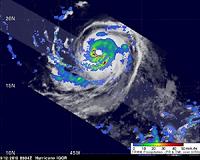 Igor stirs up Caribbean, takes aim at Bermuda
Miami (AFP) Sept 14, 2010 The most powerful Atlantic storm of 2010, Hurricane Igor, whipped up dangerous swells in the Caribbean on Tuesday as it barreled west-northwest in the direction of Bermuda. Igor, packing winds of 145 miles (230 kilometers) per hour is a category four hurricane, the second highest notch on the five-point Saffir-Simpson scale, and forecasters warned it was "getting stronger." As the powerf ... read more |
|
|
| The content herein, unless otherwise known to be public domain, are Copyright 1995-2010 - SpaceDaily. AFP and UPI Wire Stories are copyright Agence France-Presse and United Press International. ESA Portal Reports are copyright European Space Agency. All NASA sourced material is public domain. Additional copyrights may apply in whole or part to other bona fide parties. Advertising does not imply endorsement,agreement or approval of any opinions, statements or information provided by SpaceDaily on any Web page published or hosted by SpaceDaily. Privacy Statement |


 del.icio.us
 Digg
Digg Reddit
 YahooMyWeb
 Google
 Facebook


