
 |
 |
 |
 |
 |
 |
 |
 |
 |

 |
Radio Astronomers Detect Water Maser Emission From The Saturnian System
Dwingeloo, Netherlands (SPX) Feb 05, 2009 The presence of water has long been seen as a key condition for life in planetary environments. Prompted by recent discovery by the NASA's Cassini spacecraft of a water vapour "plume" emanating from Enceladus, one of the Saturnian satellites, radio astronomers wondered how abundant water is in the system of Saturn. The so-called maser emission of water molecules offers the most sensitive and robust way of detecting water vapour at radio wavelengths. This emission is unmistakably recognisable via its spectral feature at the wavelength of 1.35 cm. The discovery of the water maser emission coming from the clouds of water vapour in the Saturnian system is published in this week's issue of Astronomy and Astrophysics (Pogrebenko et al., 2009, Astronomy and Astrophysics 494, L1 - L4). An international team of radio astronomers led by Dr. Sergei Pogrebenko of the Joint Institute for VLBI in Europe (JIVE, Dwingeloo, The Netherlands) observed the system of Saturn with radio telescopes in Medicina (INAF-IRA, Italy) and Mets�hovi (TKK-MRO, Finland) for several hundred hours hunting for the elusive spectral signature of the water maser spectral line. Their determination was rewarded: several areas associated with various bodies of the Saturn system demonstrated statistically significant indications of water vapour maser emission. "It was a challenging experiment since the spectral lines were very weak. Their emitting power was about 100 Watts, just like from a light bulb, but placed at 1.3 billion kilometres away," says Pogrebenko. Prof. M. Elitzur of the University of Kentucky (Lexington, KY, USA) adds, "The emission we have detected allows us to estimate the amount of water involved in generating these spectral lines. It's just enough to fill a few Olympic-class swimming pools." The maser emission detected in the experiment is associated not only with Enceladus where it has been expected after the Cassini's discovery, but also with Titan, Hyperion and Atlas. The latter, in fact, produces the strongest signal among all the detections. This is surprising. It looks like the Saturn satellites act as blades of a giant mixer making a water-vapour cocktail in a giant bowl. Can this water-filled bowl be a cradle of life? Prof. C. Cosmovici, head of the Italian Bioastronomy project ITASEL, is confident that this discovery will help in searching for water in extrasolar planets and ultimately assess the possibility of life development outside the solar system. "The water maser detection in the Saturnian system is a very pleasant and unexpected spin-off of the Huygens VLBI Tracking experiment conducted by our group in 2005," notes Prof. L. Gurvits (JIVE). "As often happens in science, exciting things are hard to predict." The detection of water masers offers an important insight into the physical conditions in the Saturnian system and would help to sharpen future investigations of Saturn and its satellites. The experiment offers yet another reason to "return to Saturn" after the spectacular success of Cassini and Huygens missions. ESA and NASA are considering such a joint endeavour as one possible flagship space science mission to be launched around 2020. Share This Article With Planet Earth
Related Links Joint Institute for VLBI Explore The Ring World of Saturn and her moons Jupiter and its Moons The million outer planets of a star called Sol News Flash at Mercury
 Saturn's Crazy Christmas Tilt
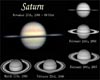 Huntsville AL (SPX) Dec 23, 2008
You look through the telescope. Blink. Shake your head and look again. The planet you expected to see in the eyepiece is not the one that's actually there. Too much eggnog? No, it's just Saturn's crazy Christmas tilt. |
|
|

| The content herein, unless otherwise known to be public domain, are Copyright 1995-2007 - SpaceDaily.AFP and UPI Wire Stories are copyright Agence France-Presse and United Press International. ESA Portal Reports are copyright European Space Agency. All NASA sourced material is public domain. Additional copyrights may apply in whole or part to other bona fide parties. Advertising does not imply endorsement,agreement or approval of any opinions, statements or information provided by SpaceDaily on any Web page published or hosted by SpaceDaily. Privacy Statement |
 del.icio.us
 Digg
Digg Reddit
 YahooMyWeb
 Google
 Facebook