
 |
 |
 |
 |
 |
 |
 |
 |
 |

 |
Raytheon's JLENS Passes Key Milestone
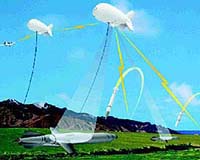
Tewksbury MA (SPX) Feb 17, 2009 Raytheon Company's JLENS (Joint Land Attack Cruise Missile Defense Elevated Netted Sensor System) has successfully conducted a critical design review representing a key milestone in the U.S. Army program to provide cruise missile defense capability for U.S. warfighters. "JLENS is moving forward to provide the soldier with key performance capabilities," said Lt. Col. Stephen Willhelm, JLENS product manager, U.S. Army Program Executive Office for Missiles and Space. "The JLENS CDR demonstrates that the design maturity is where we need it to be and reaffirms our continued confidence that this critical cruise missile defense capability is on track to be provided to our warfighters." "The JLENS team continues rapid and disciplined progress on schedule," said Pete Franklin, vice president, National and Theater Security Programs for Raytheon Integrated Defense Systems. "The success of this "Orbit" (System) CDR affirms the strength of the team and our confidence in JLENS maturity." The review thoroughly assessed all aspects of the JLENS design maturity and confidence. The successful CDR represents a key milestone event for the $1.4 billion system design and demonstration contract, under which two JLENS Orbits are being delivered. Successful completion of this milestone allows transition into the fabrication, assembly, integration and test phase of the JLENS program. JLENS provides long-duration, wide-area, over-the-horizon detection and tracking of incoming cruise missiles. At the same time, it supplies the battlefield commander with situational awareness and elevated communications capabilities to provide sufficient warning to enable air defense systems to engage and defeat threats. Each JLENS Orbit consists of two systems: a surveillance system, which includes an elevated long-range surveillance radar; and a fire control system, which includes an elevated high-performance fire control radar. Each radar is integrated onto a large aerostat, which is connected by a tether to the ground-based mobile mooring station and communications processing group. Share This Article With Planet Earth
Related Links Raytheon Learn about missile defense at SpaceWar.com Learn about nuclear weapons doctrine and defense at SpaceWar.com All about missiles at SpaceWar.com Learn about the Superpowers of the 21st Century at SpaceWar.com
 The Missile Defense Reality Check Part 13
 Washington (UPI) Feb 16, 2009
 There are some things that are worse than a weak economy, and the possibility of a nuclear attack against America's homeland, its forward-deployed forces or its allies is one of those things. |
|
|

| The content herein, unless otherwise known to be public domain, are Copyright 1995-2007 - SpaceDaily.AFP and UPI Wire Stories are copyright Agence France-Presse and United Press International. ESA Portal Reports are copyright European Space Agency. All NASA sourced material is public domain. Additional copyrights may apply in whole or part to other bona fide parties. Advertising does not imply endorsement,agreement or approval of any opinions, statements or information provided by SpaceDaily on any Web page published or hosted by SpaceDaily. Privacy Statement |
 del.icio.us
 Digg
Digg Reddit
 YahooMyWeb
 Google
 Facebook