
 |
 |
 |
 |
 |
 |
 |
 |
 |

 |
Raytheon Reaches Key Milestones With Troposcatter Solution
Marlborough MA (SPX) Mar 05, 2009 In a recent exercise with the U.S. Army, Raytheon achieved an industry-first wireless transmission of its lightweight High Capacity Beyond Line-of-Sight troposcatter system. "This exercise illustrates that Raytheon's solution has proven interoperability with existing communication architectures and is adaptable to the warfighter's mobile needs in the field," said Jerry Powlen, vice president, Network Centric Systems' Integrated Communications Systems. The Ku band HC BLOS system delivers voice, video and data via troposcatter, transmitting radio waves over the curvature of the Earth without using satellites. It can establish a high-capacity data link - up to 40 megabytes per second - for up to 120 miles. In the demonstration, the system successfully provided long-range network connections to several different wireless technologies. The system used Raytheon's Enhanced Position Location Reporting System to stream real-time video more than 30 miles between Forts Monmouth and Dix, N.J. Additional wireless networks provided full voice, video and data capabilities between Wideband Code Division Multiple Access (W-CDMA) base stations and also provided portable Internet access between Worldwide Interoperability for Microwave Access (WiMAX) nodes. This milestone comes on the heels of the first-ever delivery of the HC BLOS. Under a $2.2 million contract, Raytheon is providing two HC BLOS terminals and training to the Canadian Forces. Wideband Code Division Multiple Access, or W-CDMA, is a cellular network supporting a wide range of voice, video and data services. Worldwide Interoperability for Microwave Access, or WiMAX, is a wireless technology supporting mobile Internet access among a variety of devices. Share This Article With Planet Earth
Related Links Raytheon Read the latest in Military Space Communications Technology at SpaceWar.com
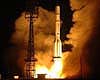
 Russian military satellite in orbit after launch
 Moscow (UPI) Feb 28, 2009
 A Russian military satellite is now in orbit above the Earth after being launched with a Proton-K heavy carrier rocket Saturday, an official says. |
|
|

| The content herein, unless otherwise known to be public domain, are Copyright 1995-2007 - SpaceDaily.AFP and UPI Wire Stories are copyright Agence France-Presse and United Press International. ESA Portal Reports are copyright European Space Agency. All NASA sourced material is public domain. Additional copyrights may apply in whole or part to other bona fide parties. Advertising does not imply endorsement,agreement or approval of any opinions, statements or information provided by SpaceDaily on any Web page published or hosted by SpaceDaily. Privacy Statement |

 del.icio.us
 Digg
Digg Reddit
 YahooMyWeb
 Google
 Facebook