|
 |
 |
 |
 |
 |
 |
 |

| . |  |
. |

|
|
. |

 by Tracey Bryant Newark, DE (SPX) Oct 12, 2011
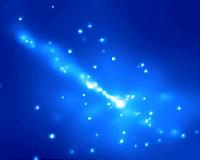
In the Crab Nebula, in the constellation Taurus, a remnant of an exploded star has astrophysicists scratching their heads, reassessing their theories about gamma rays - the highest-energy form of light, generated by subatomic particles moving close to the speed of light. In the center of the Crab Nebula, the Crab Pulsar, a spinning neutron star left over when a supernova exploded, is pulsing out gamma rays with energies never seen before - above one hundred thousand million electron volts, according to an international scientific team that includes researchers from the University of Delaware. The findings are reported in the journal Science. The journal article has 95 authors, including scientists from 26 institutions in five countries, who are part of the VERITAS collaboration. VERITAS, or Very Energetic Radiation Imaging Telescope Array System, is a ground-based observatory for gamma-ray astronomy located at the Fred Lawrence Whipple Observatory in southern Arizona. It is operated by a collaboration of more than 100 scientists from 22 different institutions in the United States, Ireland, England, Germany and Canada. "This is a really exciting and unexpected result," says Jamie Holder, assistant professor in the UD Department of Physics and Astronomy. Holder's group in the Bartol Research Institute at UD helped to construct the VERITAS telescopes. Members of the Delaware group collected a portion of the data for this study and developed some of the software used in the analysis. "Existing theories of gamma rays from pulsars predict a sharp cut-off in the emission at high energies, around 10 thousand million electron volts. Our data show gamma rays with energies at least 20 times this, implying that the gamma rays are being produced in a different place, and probably by a different mechanism, than expected," Holder says. Holder points out that when a gamma ray hits the atmosphere, it produces a small flash of blue light that lasts only a few billionths of a second. The VERITAS cameras take 200 photographs a second. He and his team developed software that would sift out the gamma rays from all of the background noise, representing about one-tenth of the images. "Our software throws away all the stuff that isn't gamma rays," he says. Holder says that he and his colleagues will keep observing the Crab Pulsar for the next few years, as the spinning star continues to wind down. With so much radioactivity being spun out, are there any implications for us here on Earth? As Holder notes, gamma rays are ever-present in the universe, and fortunately Earth's atmosphere protects us from them. Currently, Holder and his group at UD are in the middle of building 2,000 photo detectors for the new cameras for the VERITAS telescopes. "The new photodetectors collect 50 percent more light than our existing ones, which will make us more sensitive to gamma rays, particularly in the energy range where the Crab Pulsar emits," Holder notes. VERITAS is funded by the U.S. National Science Foundation, U.S. Department of Energy Office of Science, Smithsonian Institution, Natural Sciences and Engineering Research Council of Canada, Science Foundation Ireland, and Science and Technology Facilities Council of the United Kingdom. The Bartol Research Institute is a research center in UD's Department of Physics and Astronomy. The institute's primary function is to carry out forefront scientific research with a primary focus on physics, astronomy, and space sciences.
Fred Lawrence Whipple Observatory Stellar Chemistry, The Universe And All Within It
|
. |
|
| The content herein, unless otherwise known to be public domain, are Copyright 1995-2011 - Space Media Network. AFP and UPI Wire Stories are copyright Agence France-Presse and United Press International. ESA Portal Reports are copyright European Space Agency. All NASA sourced material is public domain. Additional copyrights may apply in whole or part to other bona fide parties. Advertising does not imply endorsement,agreement or approval of any opinions, statements or information provided by Space Media Network on any Web page published or hosted by Space Media Network. Privacy Statement |

 del.icio.us
 Digg
Digg Reddit
 Google