
 |
 |
 |
 |
 |
 |
 |
 |
 |

 |

New York NY (SPX) Dec 22, 2010 Hydrologists may have a new way to study historical water conditions. By synthesizing present-day data with historical records they may be able to recreate broad hydrologic trends on a regional basis for periods from which scant data is available. Lack of reliable historical data can impede hydrologists' understanding of the current state of waterways and their ability to make predictions about the future. That was the case for the rivers of the northeastern United States between 1600 and 1800, a period that runs from just before the first European settlers arrived to the onset of the Industrial Age. "The historic perspective is important because humans have developed a particular approach to water that may not be sustainable," says Dr. Charles Vorosmarty, presidential professor of civil engineering in The Grove School of Engineering at The City College of New York. "(People) often impact a system and then spend lots of money to fix it. By studying how systems evolved, we may be able to look at success stories of the past and avoid problems emerging today and in other parts of the world." Professor Vorosmarty was principal investigator for the study, which was produced by an interdisciplinary team of researchers from 15 institutions. It was one of just two funded under the National Science Foundation's Continental Hydrological Processes Program, and is a major component of a multi century-scale study of waterways in an area stretching from Maine to Chesapeake Bay. "The reconstruction makes it possible to discern broad hydrologic trends," said Christopher L. Pastore, a University of New Hampshire historian and corresponding author for the report, which was published this month in "Environmental Science and Technology." "We're laying the groundwork for understanding the big picture: how Americans interacted with and changed their water resources over the broad sweep of time." Graduate students attending a summer institute at Massachusetts Institute of Technology developed the conceptual model and recommendations. They identified four principal drivers of hydrological change: water engineering, land-cover change, climate change and human decision-making. The latter was overarching because it affects the other three. The model identified a baseline environment for the year 1600 and then worked forward. Europeans' impact on the waterways was felt soon after they arrived, Professor Vorosmarty noted. For example, demand for beaver pelts reduced their population, and the dams the beavers had built collapsed because they were no longer being maintained. The signature of these changes was mapped on a regional scale and found to be substantial. To develop their methodological model, the team first projected known data sets into a geographic information system and conducted simulations using hydrological models that were calibrated to modern data sets. Further corroboration was achieved, for example, by using British census records and local histories. From these, they could estimate deforestation patterns and local hydrology change. Where possible, they scaled up these hydrological "snapshots" to make assertions across a larger area. To apply the model, the team divided the region into three historically consistent sub-regions - New England, the mid-Atlantic colonies and the Chesapeake Bay area - and studied the effects of physical variables such as soil and climate and sociopolitical factors. These human factors had significant impact on hydrological development. While the close-knit, religious communities of New England concentrated on fur trading and timber extraction, Chesapeake region saw widespread tree clearance and tobacco planting. In addition to showing how the results of studies based on contemporary data sets can be corroborated with the accounts of environmental historians to reconstruct colonial-era hydrology, the work "underscores the importance of forging scholarly ties between the sciences and humanities." "This opens the disciplines to new ways of thinking," Professor Vorosmarty said. "Geoscientists may be keyed into numerical data, use of maps and other quantitative data while historians take narratives and look at other information to construct a picture. "We can assemble a picture that starts with information sets and they can corroborate what the data show. The historical scholarship community can take their studies to the next level by adapting quantitative information so the specifics they find through documenting local-scale histories can be reconfigured into broader generalizations."
Share This Article With Planet Earth
Related Links CCNY Water News - Science, Technology and Politics

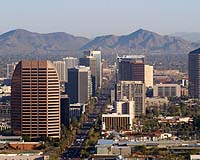 A Positive Step In The Face of Uncertainty
Tempe AZ (SPX) Dec 20, 2010 Enormous uncertainty. These two words describe the condition of Phoenix's climate and water supply in the 21st century. Reservoirs have dipped to their lowest levels, continuous drought has plagued the state and forecasts for even warmer summers are predicted. Despite this uncertainty, professors at Arizona State University say there's no need to be fearful because positive impacts can be made. ... read more |
|
|
| The content herein, unless otherwise known to be public domain, are Copyright 1995-2010 - SpaceDaily. AFP and UPI Wire Stories are copyright Agence France-Presse and United Press International. ESA Portal Reports are copyright European Space Agency. All NASA sourced material is public domain. Additional copyrights may apply in whole or part to other bona fide parties. Advertising does not imply endorsement,agreement or approval of any opinions, statements or information provided by SpaceDaily on any Web page published or hosted by SpaceDaily. Privacy Statement |


 del.icio.us
 Digg
Digg Reddit
 YahooMyWeb
 Google
 Facebook


