
 |
 |
 |
 |
 |
 |
 |
 |
 |

 |
Researchers Discover Primer To Plant Defense System
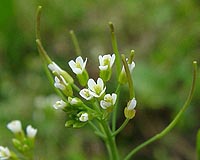
Oak Ridge TN (SPX) Apr 04, 2009 By identifying a novel compound that primes a plant's immune system, researchers at Oak Ridge National Laboratory and the University of Chicago may be on a path to developing disease-resistant plants. In a paper published in Science, a team that includes Tim Tschaplinski of the Department of Energy's ORNL reports that azelaic acid has a role in priming the immunity response in Arabidopsis, a small flowering plant related to cabbage and mustard. This plant, commonly known as thale cress or mouse-ear cress, is widely used as a model organism for studying higher plants. While Tschaplinski acknowledged that this field is in its infancy and involves a very complex network of responses, he and co-authors are excited about what may lie ahead. "Long term, this discovery may prove useful for preventing diseases in crops and other plants, and perhaps for generating plants that are more disease-resistant in the first place," said Tschaplinski, a member of ORNL's Environmental Sciences Division. The discovery was actually made when Tschaplinski kept noticing a persistent mass spectral signature that occurred soon after Arabidopsis plants were exposed to a bacterial pathogen. The signal matched a pattern in a database of mass spectral signatures of Arabidopsis metabolites and prompted Tschaplinski to have a conversation with the University of Chicago's Jean Greenberg and postdoctoral scholar Ho Won Jung. Their discussion led to some additional research and this paper, titled "Priming in Systemic Plant Immunity." Among key findings was that plants can boost their overall immunity to infection once they have a local exposure to certain pathogenic microbes. This occurs through a series of steps, beginning with a primary infection that causes the plant to induce defenses to contain the spread and growth of the pathogen. The infection causes the plant to produce more azelaic acid, which stimulates the production of AZ11, a protein that the researchers found to be essential for the increased systemic plant immunity. Azelaic acid moves throughout the stem and leaves and bolsters the plant's immune system so it can respond quicker and more effectively to diseases compared to na�ve plants, according to the researchers. Through this process, plants accumulate very high levels of the defense signal salicylic acid, and this helps inhibit the progression of secondary infections. "With respect to future science, a number of other novel signatures are clearly evident and can be pursued as a component of the plant-microbe scientific focus area if that is a route we decide to go," Tschaplinski said. In the meantime, the authors note that, "The identification of novel systemic acquired resistance components may be useful for plant protection and provides new insight into how some interactions trigger systemic plant immunity." Other authors are Lin Wang and Jane Glazebrook of the University of Minnesota. Funding for the research, led by Greenberg, was provided by DOE's Office of Science and the National Science Foundation. UT-Battelle manages Oak Ridge National Laboratory for the Department of Energy. Share This Article With Planet Earth
Related Links Oak Ridge National Laboratory Darwin Today At TerraDaily.com
 Permian Extinction Not A Global Event
 Boulder CO (SPX) Apr 04, 2009
Understanding the cause of the extinction that wiped out some 95% of the living species at the end of the Palaeozoic Era has been one of the greatest problems in the earth and life sciences. |
|
|

| The content herein, unless otherwise known to be public domain, are Copyright 1995-2007 - SpaceDaily.AFP and UPI Wire Stories are copyright Agence France-Presse and United Press International. ESA Portal Reports are copyright European Space Agency. All NASA sourced material is public domain. Additional copyrights may apply in whole or part to other bona fide parties. Advertising does not imply endorsement,agreement or approval of any opinions, statements or information provided by SpaceDaily on any Web page published or hosted by SpaceDaily. Privacy Statement |
 del.icio.us
 Digg
Digg Reddit
 YahooMyWeb
 Google
 Facebook