
 |
 |
 |
 |
 |
 |
 |
 |
 |

 |

Moffett Field CA (SPX) Mar 08, 2011 Diatoms account for a large proportion of the phytoplankton found in the water, and live both in the open sea and in freshwater lakes. By reviving 100-year-old spores that had laid buried and inactive in bottom sediment, researchers at the University of Gothenburg, Sweden, have shown that diatoms are also genetically stable and survival artists. Recent research has shown that diatoms exhibit great genetic differences and that they occur in discrete populations, which means that they multiply sexually to a greater extent than previously believed. What makes diatoms special is that if the environment they live in becomes too inhospitable they form resting spores, which gather in sediment at the bottom of the sea. When conditions improve, the spores can be revived. The study concerned is based on a sample of sediment from a highly eutrophic Danish fjord on the east coast of Jutland, Mariager Fjord, whose anoxic bottoms and bottom sediments today do not show any signs of life. After dating the different layers of a sediment core, the researchers took small pieces of sediment from various depths and transferred them to an environment favourable to diatoms. This enabled them to revive resting spores. "We revived hundreds of genetic individuals of diatoms and induced them to start dividing again and to form cloned cultures. The oldest are more than 100 years old, the youngest quite fresh. We then identified the revived individuals genetically," says Anna Godhe of the Department of Marine Ecology at the University of Gothenburg.
40 000 generations of diatoms "We found certain differences between the algae that went into a state of rest at the start of the 20th century compared with those that formed resting spores when the eutrophication was at its worst and the freshest ones of all, but the individuals are for the most part very homogeneous throughout the sediment core, that's to say 40 000 generations of diatoms."
No traces of genetic impact over 100 years The researchers believe that this is due to the fact that the algae that live inside the fjord are so superbly well adapted to the fjord environment and that there are so many of them (millions per litre of water, thousands per gram of sediment) that colonizers from outside are rapidly out-competed.
Share This Article With Planet Earth
Related Links University of Gothenburg Darwin Today At TerraDaily.com

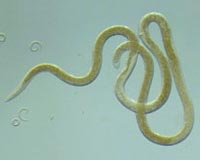 Worms Strike See-Saw Balance In Disease Resistance
London UK (SPX) Mar 08, 2011 New research, funded by the Biotechnology and Biological Sciences Research Council (BBSRC) has shown that nematode worms have to trade-off resistance to different diseases, gaining resistance to one microbe at the expense of becoming more vulnerable to another. This finding, published in PLoS ONE (2 March 2011), reveals that the worms, called C. elegans, have a much more complex immune system th ... read more |
|
|
| The content herein, unless otherwise known to be public domain, are Copyright 1995-2010 - SpaceDaily. AFP and UPI Wire Stories are copyright Agence France-Presse and United Press International. ESA Portal Reports are copyright European Space Agency. All NASA sourced material is public domain. Additional copyrights may apply in whole or part to other bona fide parties. Advertising does not imply endorsement,agreement or approval of any opinions, statements or information provided by SpaceDaily on any Web page published or hosted by SpaceDaily. Privacy Statement |


 del.icio.us
 Digg
Digg Reddit
 YahooMyWeb
 Google
 Facebook


