|
Revving Up The World's Fastest Nanomotors
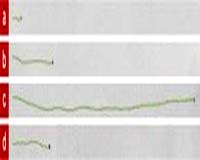
Washington DC (SPX) May 05, 2008 In a "major step" toward a practical energy source for powering tomorrow's nanomachines, researchers in Arizona report development of a new generation of sub-microscopic nanomotors that are up to 10 times more powerful than existing motors. Their study is scheduled for the May 27 issue of ACS Nano, a monthly journal. In the new study, Joseph Wang and colleagues point out that existing nanomotors, including so-called "catalytic nanomotors," are made with gold and platinum nanowires and use hydrogen peroxide fuel for self-propulsion. But these motors are too slow and inefficient for practical use, with top speeds of about 10 micrometers per second, the researchers say. One micrometer is about 1/25,000 of an inch or almost 100 times smaller than the width of a human hair. Wang and colleagues supercharged their nanomotors by inserting carbon nanotubes into the platinum, thus boosting average speed to 60 micrometers per second. Spiking the hydrogen peroxide fuel with hydrazine (a type of rocket fuel) kicked up the speed still further, to 94- 200 micrometers per second. This innovation "offers great promise for self-powered nanoscale transport and delivery systems," the scientists state. Community Email This Article Comment On This Article Related Links American Chemical Society Nano Technology News From SpaceMart.com Computer Chip Architecture, Technology and Manufacture
 Lockheed Martin And Rice Partner On Nanotech Research
 Houston TX (SPX) Apr 28, 2008
Lockheed Martin and Rice University have announced the creation of an innovative, strategic partnership to develop new technologies for a broad range of applications in electronics, energy and security. The Lockheed Martin Advanced Nanotechnology Center of Excellence at Rice University, or LANCER, will pair researchers from Lockheed Martin with Rice experts in carbon nanotechnology, photonics, plasmonics and more. |
|
|
| The content herein, unless otherwise known to be public domain, are Copyright Space.TV Corporation. AFP and UPI Wire Stories are copyright Agence France-Presse and United Press International. ESA Portal Reports are copyright European Space Agency. All NASA sourced material is public domain. Additional copyrights may apply in whole or part to other bona fide parties. Advertising does not imply endorsement, agreement or approval of any opinions, statements or information provided by Space.TV Corp on any Web page published or hosted by Space.TV Corp. Privacy Statement |