
 |
 |
 |
 |
 |
 |
 |
 |
 |

 |
Rheinmetall Develops USV For German Navy
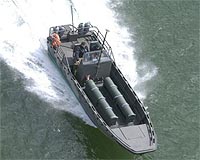
Bonn, Germany (SPX) Nov 26, 2008 The German Navy has contracted with Rheinmetall Defence to retrofit and supply it with a robotic boat capable of carrying out a variety of missions. In developing the Unmanned Sea Vehicle (USV), Rheinmetall is transferring its tremendous expertise in the field of unmanned terrestrial vehicles to new maritime applications. The order is worth around EUR1.3 million. Under a research and development contract awarded by Germany's Federal Office for Defence Technology and Procurement, Rheinmetall is integrating robotic components into a Watercat M8 fast attack boat made by Marine Alutech Oy Ab of Finland. Initially to be used for evaluation purposes, the boat will be capable of manned and unmanned operations. In contemporary operations where the main threat is often asymmetric, the special capabilities of the USV mean that it can make a valuable contribution as a reconnaissance asset, carrying out sustained monitoring and/or interception of hostile speedboats. Equipped with appropriate mission modules, unmanned sea vehicles can conduct operations where deploying human beings is extremely hazardous, e.g. capturing drifting contact mines. The system thus makes a tangible contribution to force protection at sea. Weighting just under two tons and measuring approximately eight metres in length, the boat has a top speed of 35 knots. It can operate in manned mode, autonomously, or in remote control mode, and also features automatic waypoint navigation. Moreover, the boat's comprehensive array of sensors significantly expands the surveillance coverage of the carrying vessel. At a later stage, following sea trials, Rheinmetall hopes to supply the armed forces with several of this versatile craft. Share This Article With Planet Earth
Related Links Rheinmetall Defence Naval Warfare in the 21st Century
 Another Nulka Anti-Missile Decoy System Milestone
 Melbourne, Australia (SPX) Nov 20, 2008
BAE Systems has announced that its Nulka Anti-Missile Decoy System has achieved yet another significant milestone - installation on the 100th US Navy warship. |
|
|

| The content herein, unless otherwise known to be public domain, are Copyright 1995-2007 - SpaceDaily.AFP and UPI Wire Stories are copyright Agence France-Presse and United Press International. ESA Portal Reports are copyright European Space Agency. All NASA sourced material is public domain. Additional copyrights may apply in whole or part to other bona fide parties. Advertising does not imply endorsement,agreement or approval of any opinions, statements or information provided by SpaceDaily on any Web page published or hosted by SpaceDaily. Privacy Statement |
 del.icio.us
 Digg
Digg Reddit
 YahooMyWeb
 Google
 Facebook