
 |
 |
 |
 |
 |
 |
 |
 |
 |

 |
Rivers Of Gas Flow Around Stars
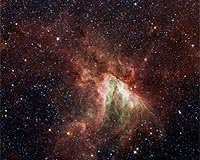
Los Angeles CA (SPX) Dec 09, 2008 A new image from NASA's Spitzer Space Telescope shows a turbulent star-forming region, where rivers of gas and stellar winds are eroding thickets of dusty material. The picture provides some of the best examples yet of the ripples of gas, or bow shocks, that can form around stars in choppy cosmic waters. "The stars are like rocks in a rushing river," said Matt Povich of the University of Wisconsin, Madison. "Powerful winds from the most massive stars at the center of the cloud produce a large flow of expanding gas. This gas then piles up with dust in front of winds from other massive stars that are pushing back against the flow." Povich is lead author of a paper describing the new findings in the Dec. 10 issue of the Astrophysical Journal. Dominating the center of the Swan is a group of massive stars, some exceeding 40 times the mass of our sun. These central stars are 100,000 to one million times as bright as the sun, and roar with radiation and fierce winds made of charged particles that speed along at up to 7.2 kilometers per hour (4.5 million miles per hour). Both the wind and radiation carve out a deep cavity at the center of the picture - an ongoing process thought to trigger the birth of new stars. The growth of this cavity pushes gas up against winds from other massive stars, causing "smiley-faced" bow shocks - three of which can be seen in the new picture. The direction of the bow shocks tells researchers exactly which way the "wind is blowing." "The bow shocks are like interstellar weather vanes, indicating the direction of the stellar winds in the nebula," said Povich. Povich and his colleagues also used Spitzer to take an infrared picture of a star-forming region called RCW 49. Both photographs are described in the same Astrophysical Journal paper, and both provide the first examples of multiple bow shocks around the massive stars of star-forming regions. Spitzer was able to spot the bow shocks because its infrared eyes can pierce intervening dust, and because it can photograph large swaths of sky quickly. Ultimately, the new observations will help researchers understand how solar systems like our own are able to form and persist in the rough, celestial seas of space. "The gas being lit up in these star-forming regions looks very wispy and fragile, but looks can be deceiving," said co-author Robert Benjamin of the University of Wisconsin, Whitewater. "These bow shocks serve as a reminder that stars aren't born in quiet nurseries but in violent regions buffeted by winds more powerful than anything we see on Earth." Share This Article With Planet Earth
Related Links Spitzer Stellar Chemistry, The Universe And All Within It
 A Celestial Snow Globe Of Stars
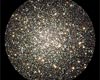 Baltimore MD (SPX) Dec 05, 2008
Like a whirl of shiny flakes sparkling in a snow globe, Hubble catches an instantaneous glimpse of many hundreds of thousands of stars moving about in the globular cluster M13, one of the brightest and best-known globular clusters in the northern sky. This glittering metropolis of stars is easily found in the winter sky in the constellation Hercules and can even be glimpsed with the unaided eye under dark skies. |
|
|

| The content herein, unless otherwise known to be public domain, are Copyright 1995-2007 - SpaceDaily.AFP and UPI Wire Stories are copyright Agence France-Presse and United Press International. ESA Portal Reports are copyright European Space Agency. All NASA sourced material is public domain. Additional copyrights may apply in whole or part to other bona fide parties. Advertising does not imply endorsement,agreement or approval of any opinions, statements or information provided by SpaceDaily on any Web page published or hosted by SpaceDaily. Privacy Statement |
 del.icio.us
 Digg
Digg Reddit
 YahooMyWeb
 Google
 Facebook