
 |
 |
 |
 |
 |
 |
 |
 |
 |

 |
Russia Defense Watch: Aircraft for India
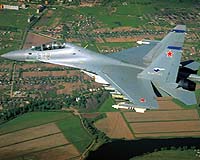
Washington, April 22, 2009 Russia has secured its position as the supplier of military aircraft to India for the first quarter of the 21st century, a highly influential Moscow think tank has concluded. India will continue to buy most of its combat aircraft from Russia for at least the next 15 years because of contracts that have already been concluded and the further deals that are almost certain to develop out of them, the Center for Analysis of Strategies and Technologies concluded in a report titled "The Forecast for Combat Aircraft Deliveries to India," RIA Novosti reported Monday. The report said the Indian government had already committed to purchasing as many as 90 Sukhoi Su-30MKI combat fighters and is likely to buy more, or possibly extra Mikoyan-Gurevich MiG-29K aircraft. The sales are likely to become even more impressive. Russia is also seeking to persuade India to buy 126 new MiG-35 Fulcrum multi-role combat fighters worth $10.6 billion. New Delhi has launched an international tender to compete for the contract, but the MiG-35 is widely tipped as the favorite. RIA Novosti also noted that the MiG-35 would benefit from the long and still growing track record of close technical cooperation in military projects between Russia and India. The Indians are very pleased with the BrahMos Indian-Russian joint company that has developed a new Mach 2.8 supersonic cruise missile for the Indian armed forces. The missile is already in operational use with the Indian army and navy, and an air-launched cruise missile version for the Indian air force is also far advanced. The report also noted that in March 2008, the Kremlin signed another deal with the Indian Defense Ministry to modernize some 70 MiG-29 fighters that had been operated by the Indian air force since the 1980s. Russia is also helping India to design its own new fifth-generation fighter. Major aerospace companies from around the world are seeking orders from New Delhi to modernize and replace many of India's existing fleet of mostly Soviet-built combat aircraft, which still in large part relies on old MiG-21s, the report said. The Republican Bush administration courted India as a major strategic partner during its eight years in office, but during all that time successive Indian governments led by both the right-wing Bharatiya Janata Party and the center-left UPA-Congress alignment refused to give major U.S. defense contractors any significant contracts and effectively froze them out of air force procurement deals while continuing to award ever larger ones to Russia. Since U.S. President Barack Obama took office, U.S.-Indian relations have deteriorated in significant part because of Indian fears that Obama, Secretary of State Hillary Clinton and U.S. envoy Richard Holbrooke want to take a role in negotiating the future of Kashmir between India and Pakistan, an issue India regards as a purely internal affair.
Russian expert denies Strela missiles were sold to Venezuela According to press reports, President Hugo Chavez had announced his country had already received the missiles and that it had even created a new military formation to operate them. However, on Monday, RIA Novosti quoted Anatoly Aksenov, who it described as "a senior adviser to the general director of Russian arms-export monopoly Rosoboronexport," as saying the report appeared to refer to Strela -- otherwise known as Grail -- SAM systems, and he said Russia had not given any to Venezuela. Aksenov acknowledged that Venezuelan troops were already equipped with less formidable Russian-made Igla surface-to-air missiles, but they had already been using them for a number of years, he said. "They were supplied to the Venezuelan side a long time ago and have been shown" at a military parade in Venezuela, Aksenov stated, according to the report. Last weekend, U.S. President Barack Obama met with Chavez, the most outspokenly anti-American leader in Latin America, at the 34-nation Summit of the Americas in Trinidad and Tobago in an effort to improve relations. Chavez has embarked on a breakneck program to expand Venezuela's armed forces, including its capabilities for power projection into neighboring countries using heavy military air transports, or airlifters. In the past few years, he has bought more than $4 billion in arms and military equipment from Russia alone, RIA Novosti said. In addition, Chavez has also made major arms purchases from China and Spain. RIA Novosti described the Strela as "a man-portable, shoulder-fired, low-altitude surface-to-air missile system with an effective range of approximately 6,000 meters." It said the Igla -- also known as the Grouse -- was a less advanced missile with a range of 3,500 meters. Share This Article With Planet Earth
Related Links The Military Industrial Complex at SpaceWar.com Learn about the Superpowers of the 21st Century at SpaceWar.com
 Russian president laments unfit conscripts
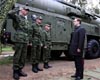 Moscow (AFP) April 22, 2009
Russian President Dmitry Medvedev said on Wednesday that over 40 percent of those eligible for military service were not fit enough, amid a government drive to modernise the armed forces. |
|
|

| The content herein, unless otherwise known to be public domain, are Copyright 1995-2007 - SpaceDaily.AFP and UPI Wire Stories are copyright Agence France-Presse and United Press International. ESA Portal Reports are copyright European Space Agency. All NASA sourced material is public domain. Additional copyrights may apply in whole or part to other bona fide parties. Advertising does not imply endorsement,agreement or approval of any opinions, statements or information provided by SpaceDaily on any Web page published or hosted by SpaceDaily. Privacy Statement |
 del.icio.us
 Digg
Digg Reddit
 YahooMyWeb
 Google
 Facebook