
 |
 |
 |
 |
 |
 |
 |
 |
 |

 |
Russia Defense Watch: UAVs from Israel
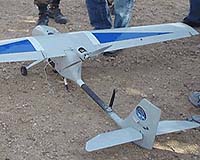
Washington (UPI) April 13, 2009 Russia has closed a deal with Israel's largest aerospace company to buy new state-of-the-art unmanned aerial vehicles. Russian Deputy Defense Minister Vladimir Popovkin, who directs all military procurement programs, confirmed the deal in an announcement Friday, RIA Novosti reported. Previously, the Moscow daily business newspaper Kommersant had published what it said were details of the deal on April 7. "We have closed a deal with an Israeli company on the delivery of a range of UAVs," Popovkin announced, according to the report. According to the Kommersant report, the Russian government has concluded an agreement with Israel Aerospace Industries to buy the Bird-Eye 400 mini-UAV, the I-View MK150 tactical UAV and the Searcher Mk II medium-range UAV. The Bird-Eye 400 weighs 11 pounds and has a range of 6 miles. The I-View MK150 weighs 352 pounds and has a range of 60 miles. The Searcher Mk II weighs 937 pounds and has a range of 150 miles. The tactical importance of the contract with Israel Aerospace Industries is very great. The Russian army in general performed very impressively in its blitzkrieg occupation of one-third of the territory of the former Soviet republic of Georgia in the Caucasus last August. However, Russian military analysts and reports published after the conflict stressed the weakness of battlefield intelligence and a grave weakness in intelligence, surveillance and reconnaissance technology. Several Russian air force combat aircraft were also lost to unexpectedly effective U.S.-supplied Georgian air defenses. RIA Novosti noted that Russian analysts had concluded that "the effectiveness of Russian military operations was severely hampered by the lack of reliable intelligence." Israel has prioritized UAV development in recent years and is regarded as a world leader in advancing the technology. The Russian air force has already started high-priority UAV development programs of its own. The RIA Novosti report noted that last year, three-star Col. Gen. Alexander Zelin, the air force commander, announced the goal of putting UAVs into operational use by 2011 that could fly as far as 240 miles and could stay in the air as long as 12 hours. However, this ambitious target appears to be beyond the current resources and technical capabilities of the Russian defense industry. "Russian defense companies, including the MiG corporation, the Russian Helicopters and the Vega Radio Engineering Corp., have failed so far to provide the military with effective spy drones," RIA Novosti said. Popovkin revealingly remarked that the purchase of the UAVs -- spy drones -- from Israel was a temporary bridging measure. But he also indicated that the Israeli UAVs would be reverse-engineered and carefully studied "to show our industry what it (a spy drone) is." "We will rely on our own equipment to fight wars," he added. RIA Novosti said that recent studies had concluded the Russian armed forces require at least 100 UAVs using a minimum of 10 guidance systems to reach the required level of battlefield reconnaissance in any future conventional war it may have to fight. Share This Article With Planet Earth
Related Links UAV News - Suppliers and Technology
 Russia buys unmanned drones from Israel: report
 Moscow (AFP) April 7, 2009
Russia has purchased its first unmanned drones from Israel after its own manufacturers turned out to be ineffective at making the high-tech reconnaissance aircraft, a newspaper reported Tuesday. |
|
|

| The content herein, unless otherwise known to be public domain, are Copyright 1995-2007 - SpaceDaily.AFP and UPI Wire Stories are copyright Agence France-Presse and United Press International. ESA Portal Reports are copyright European Space Agency. All NASA sourced material is public domain. Additional copyrights may apply in whole or part to other bona fide parties. Advertising does not imply endorsement,agreement or approval of any opinions, statements or information provided by SpaceDaily on any Web page published or hosted by SpaceDaily. Privacy Statement |
 del.icio.us
 Digg
Digg Reddit
 YahooMyWeb
 Google
 Facebook