
 |
 |
 |
 |
 |
 |
 |
 |
 |

 |
Russian Ramps Up Iskander-M Engine Production
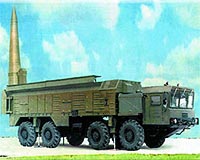
Washington (UPI) Feb 11, 2009 Russia's Omsk engine design and production bureau has begun a large-scale production of engines for the Iskander-M short-range tactical missile system, RIA Novosti reported Friday. "The company has received a large Defense Ministry order to manufacture engines for Iskander-M systems. The first batch must be supplied by the end of February," Valery Kovalchuk, Omsk bureau deputy general director, told the news agency. According to the report, Kovalchuk stated that the Omsk bureau was fully prepared to manufacture the Iskander. He said it already had lined up all necessary design, testing and production personnel and equipment necessary to start full-cycle production of the engines. The Omsk bureau would work at full capacity on producing Iskander-M engines for the next five years, he said. The RIA Novosti report noted that the Iskander-M short-range, mobile tactical missile (NATO designation SS-26 Stone) is propelled by two solid-propellant single-stage 9M723K1 guided missiles, giving it a "quasi-ballistic" capability. This ability to maneuver, combined with the Iskander-M's very low trajectory, relatively fast speed and rapid acceleration thanks to its solid fuel propellant, makes the missile very difficult to intercept after it is launched. These factors, combined with its pinpoint accuracy, make it a formidable potential pre-emptive strike weapon against the anti-ballistic missile base and radar tracking facility that the Bush administration wanted to build in Poland and the Czech Republic. The Obama administration is currently reassessing those plans. Last November Russian President Dmitry Medvedev in a nationally televised state of the union address to the Russian people threatened to deploy Iskander-Ms in Kaliningrad to target the planned U.S. BMD bases when they were built. However, since U.S. President Barack Obama was elected on Nov. 4, the Russians have not deployed a single Iskander-M yet in their Kaliningrad exclave on the Baltic Sea, where the missiles could put the proposed U.S. missile defense bases within range. Russian critics of the Iskander program have claimed the Russian defense industrial sector is too short of skilled workers, industrial capacity and raw materials to manufacture as many Iskanders as it needs to carry out its threats. However, Medvedev and Prime Minister Vladimir Putin continue to give development of the Iskander program top priority. As we reported last week in these columns, the Russian armed forces are now developing a new unmanned aerial vehicle with the specific task of providing accurate targeting data in real time to the mobile Iskander missile units. RIA Novosti noted the Iskander-M missile has a range of 250 miles and that it is capable of being armed with either conventional explosive or nuclear warheads. The Russian armed forces expect to have a minimum of five missile brigades armed and equipped with Iskander-M systems operationally deployed by 2016, RIA Novosti said. Already, two missile battalions on combat duty in the North Caucasus military district are armed with them, the news agency said, citing unnamed "military sources." As we have reported previously in these columns, Russian government and Defense Ministry officials have leaked reports that the Kremlin is willing to refrain from deploying the Iskanders and to enter into serious negotiations with the Obama administration to conclude a new strategic arms reduction treaty before the end of this year. However, the Russians insist they will negotiate a new START treaty only if the U.S. government agrees to scrap the two ballistic missile defense bases in Poland and the Czech Republic. The two bases are intended to defend the Eastern Seaboard of the United States and Western Europe against possible Iranian nuclear missile attack. As we previously have noted in these columns, boosting Iskander production is a win-win scenario for the Kremlin. Because of its very short range, Iskander production and deployment would not be limited by any strategic arms reduction treaty. And if START negotiations collapsed, or even if the treaty was signed but U.S.-Russian relations deteriorated seriously at some later point, Moscow would still have the option and resources to rapidly deploy Iskander battalions into Kaliningrad at almost no notice. Also, the Iskander is a formidable short-range tactical weapon that could be used against key military command centers and air bases in the event of any war, especially in a devastating pre-emptive attack. Share This Article With Planet Earth
Related Links Learn about missile defense at SpaceWar.com Learn about nuclear weapons doctrine and defense at SpaceWar.com All about missiles at SpaceWar.com Learn about the Superpowers of the 21st Century at SpaceWar.com
 Rayguns For The 21st Century
 Arlington, Va. (UPI) Feb 11, 2009
 The revolutionary Airborne Laser weapon consists of three major subsystems: |
|
|

| The content herein, unless otherwise known to be public domain, are Copyright 1995-2007 - SpaceDaily.AFP and UPI Wire Stories are copyright Agence France-Presse and United Press International. ESA Portal Reports are copyright European Space Agency. All NASA sourced material is public domain. Additional copyrights may apply in whole or part to other bona fide parties. Advertising does not imply endorsement,agreement or approval of any opinions, statements or information provided by SpaceDaily on any Web page published or hosted by SpaceDaily. Privacy Statement |
 del.icio.us
 Digg
Digg Reddit
 YahooMyWeb
 Google
 Facebook