|
 |
 |
 |
 |
 |
 |
 |
 |

 |
Russian Scientists To Study In Detail North Pole Expedition Samples
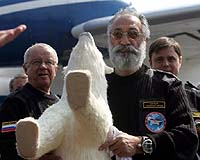
Moscow (RIA Novosti) Aug 09, 2007 Studying the geological samples taken from the North Pole seabed during Russia's symbolic expedition last week could take six months, a Russian Academy of Sciences spokesman said Wednesday. Russian researchers descended 4,200 meters (14,000 feet) below the Pole in two submersibles last Thursday to gather evidence to bolster the country's claim to a vast swathe of extra Polar territory - a mission fueling national pride at home but attracting criticism from rival Arctic powers. Yury Leonov, secretary of the academy's Department of Earth Sciences, told a news conference: "Studying the rock samples will take six months, as scientists will have to determine rock composition, formation time and the presence of organic residue." But Leonov admitted: "these probes were insufficient, and can only be regarded as a part of the research." He said more studies involving other methods were required to back the claim that the underwater Lomonosov mountain chain, discovered by Russia, is a continuation of the country's landmass. He said Russia does have some scientific data in favor of the claim. In 2001, Russia said it was entitled to an extra 1.2 million square kilometers (460,000 square miles) of territory believed to contain vast oil and gas reserves and other mineral riches likely to become accessible in future decades due to man-made global warming. The UN demanded more evidence. Speaking at the news conference, Russia's veteran explorer and lawmaker Artur Chilingarov, who led the mission, described it as a "patriotically-tinted geographical expedition." As well as collecting geological samples, the explorers planted a titanium Russian flag on the seafloor. Chilingarov said for him it was "a crazy, incredibly difficult decision to order the descent," and confessed he had left a death note for his family on the Akademik Fedorov research vessel, which brought the mini-submarines to the Pole. He said that judging by the government's growing interest in the Arctic, Russia would probably step up research in the region. Russia's Arctic stunt has provoked irritation from Canada, which has also claimed part of the Arctic shelf since 1925, and the United States, prompting the countries to raise spending on their Arctic fleets. Washington also plans to sign the UN Convention on the Law of the Sea, which sets out legal rules for all activities in the oceans and seas. Under the Convention, the five Arctic Circle countries - the U.S., Canada, Denmark, Norway and Russia - each have a 322-kilometer (200-mile) economic zone in the Arctic Ocean at the moment.
Source: RIA Novosti Community Email This Article Comment On This Article Related Links Beyond the Ice Age
 US Icebreaker To Set Off For North Pole After Russian Mission
 Washington (RIA Novosti) Aug 07, 2007
A United States icebreaker will leave Seattle Monday for an Arctic research mission shortly after Russia's identical expedition designed to lay claim to a section of the resource-rich region, the Coast Guard said. News of the Healy vessel's trip came as two Russian mini-submarines dived 14,000 feet below the Pole Thursday, planting a titanium Russian flag on the seabed in a symbolic claim to a vast slice of the Arctic territory, which Moscow says is the continuation of its continental shelf starting from Siberia. |
|
|
| The content herein, unless otherwise known to be public domain, are Copyright Space.TV Corporation. AFP and UPI Wire Stories are copyright Agence France-Presse and United Press International. ESA Portal Reports are copyright European Space Agency. All NASA sourced material is public domain. Additional copyrights may apply in whole or part to other bona fide parties. Advertising does not imply endorsement, agreement or approval of any opinions, statements or information provided by Space.TV Corp on any Web page published or hosted by Space.TV Corp. Privacy Statement |