
 |
 |
 |
 |
 |
 |
 |
 |
 |

 |
Russian Space Agency To Compensate Siberian Man Over Rocket Part
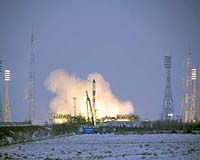
Novosibirsk, Russia (RIA Novosti) Nov 10, 2008 Russia's space agency, Roscosmos, has agreed to pay 100,000 rubles (about $4,000) in compensation to a villager in southwest Siberia after a rocket fragment fell on his land, the local administration said on Friday. Boris Urmatov, a shepherd in the Republic of Altai, earlier demanded 1 million rubles in compensation for the February 5 incident, when a three-and-a-half-meter (11 ft) fragment from a Proton-M carrier rocket, launched from the Baikonur Space Center, fell near his house. In April, two villagers sued Roscosmos after rocket parts fell on their property, which is located outside the designated area for falling debris. The local authorities have sent a letter to the space agency requesting it to take measures to prevent rocket fragments falling in populated areas. A second incident occurred on March 11 when a small fragment from another Proton rocket landed in a village in the Altai Republic destroying a shed roof. The Altai Republic has been used as a "falling field" for debris from rockets launched from the Baikonur space center, leased from Kazakhstan, for more than 40 years. Experts estimate that about 2.5 metric tons of "space waste" has fallen in unpopulated areas of the republic during this period. Many local residents say they have experienced health problem as a result, although it has not been officially confirmed.
Source: RIA Novosti Share This Article With Planet Earth
Related Links Roscosmos Station and More at Roscosmos S.P. Korolev RSC Energia Russian Space News
 Blind Engineer Provides Insight Into Soyuz Capsule Re-entry Issues
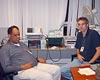 Greenbelt MD (SPX) Nov 10, 2008
A blind engineer at NASA's Goddard Space Flight Center in Greenbelt, Md., had the vision for a solution to a problem that ultimately required him to fly to Europe to obtain potentially important data on the flight of a Soyuz capsule returning two International Space Station crew members and spaceflight participant Richard Garriott to Earth. |
|
|

| The content herein, unless otherwise known to be public domain, are Copyright 1995-2007 - SpaceDaily.AFP and UPI Wire Stories are copyright Agence France-Presse and United Press International. ESA Portal Reports are copyright European Space Agency. All NASA sourced material is public domain. Additional copyrights may apply in whole or part to other bona fide parties. Advertising does not imply endorsement,agreement or approval of any opinions, statements or information provided by SpaceDaily on any Web page published or hosted by SpaceDaily. Privacy Statement |
 del.icio.us
 Digg
Digg Reddit
 YahooMyWeb
 Google
 Facebook