|
Russian army touts new bomb on television
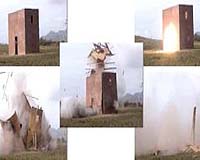
Moscow (AFP) Sept 11, 2007 Russia's army on Tuesday unveiled a new seven-tonne explosive device on national television, touting the anti-terrorism bomb as four times more powerful than the strongest US explosives. The bomb "permits us state security and at the same time the ability to battle against international terrorism in any situation, in any region," Russian Army chief General Alexandre Rushkin said. The bomb, also known as a high-impulse thermobaric weapon, disperses a cloud of hydrocarbons. It explodes in a fraction of a second, setting the area on fire and emitting very strong heat. This technology originated from the Vietnam war, where American soldiers called it "daisy clippers" because it was used to deforest jungles with devastating effect. Rushkin likened the test results to the effects of a nuclear bomb. Russian television showed a 30-metre (98-foot) four-storey building reduced to rubble after it was hit by one of these 7,100 kilogramme (16,000 pound) bombs. No independent experts were interviewed regarding the still-unnamed bomb on Russian television and it is not possible to determine how new this bomb is or the veracity of the claims made by the Russian army. The Russian defence ministry was unreachable by telephone on Tuesday evening. The television programme insisted on the weapon's "conventional" character, and noted that Russia was not involved in a new arms race. Community Email This Article Comment On This Article Related Links The latest in Military Technology for the 21st century at SpaceWar.com
 Louisiana Tech Researchers Investigate Tracking And Sensors To Assist USAF
 Baton Rouge LO (SPX) Sep 11, 2007
Two Louisiana Tech faculty members, Dr. Sumeet Dua, an assistant professor of computer science, and Dr. Rastko Selmic, an assistant professor of electrical engineering, are using their skills and technical knowledge to help the U.S. Air Force and Department of Defense with sensor networks and tracking capabilities. |
|
|
| The content herein, unless otherwise known to be public domain, are Copyright Space.TV Corporation. AFP and UPI Wire Stories are copyright Agence France-Presse and United Press International. ESA Portal Reports are copyright European Space Agency. All NASA sourced material is public domain. Additional copyrights may apply in whole or part to other bona fide parties. Advertising does not imply endorsement, agreement or approval of any opinions, statements or information provided by Space.TV Corp on any Web page published or hosted by Space.TV Corp. Privacy Statement |