|
 |
 |
 |
 |
 |
 |
 |

| . |  |
. |

|
|
. |

 by Staff Writers Guildford, UK (SPX) Oct 10, 2011
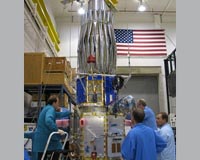
Surrey Satellite Technology Limited (SSTL) is celebrating the 30th anniversary of the launch of Surrey's first satellite, UoSAT-1. Launched into orbit on 6th October 1981, UoSAT-1 was designed and built by a team from the University of Surrey led by SSTL founder Sir Martin Sweeting. SSTL exploited the rapid advances being made in the late 1970's in microelectronics to enable the team to build a tiny but sophisticated satellite using the technology found in everyday consumer products. As a result, UoSAT-1 was much cheaper, lighter and quicker to build than comparable existing satellites and so the first modern 'microsatellite' was born. Sir Martin said: "Thirty years later we continue to exploit the amazing technological advances in consumer products to bring affordable space exploration to SSTL's customers, with a range of small satellites spanning 6kg to 600kg for Earth observation, communications and navigation services. "Working with the Surrey Space Centre on new concepts for small satellites, SSTL maintains its highly innovative approach - challenging and changing the economics of space." Between 1979 and 1981 a dedicated team of four staff and eight part-time academics worked day and night to build this first British amateur spacecraft, learning satellite design and construction "on the fly". Using donated materials and a home made clean-room, UoSAT-1 was the pioneer of the cost effective "commercial off-the-shelf" (COTS) based small satellites for which SSTL has become synonymous. In the early 1980's satellite equipment was purpose-built for space at huge expense taking many years, so that the technology used was often obsolete by launch. With very limited onboard storage and processing power, the Earth observation and science satellites of the day were micro-managed using expensive world-wide ground station networks to command them and gather data as they orbited the globe. The mass production that fed the public's appetite for microcomputers made microprocessors and memory suddenly very affordable. With re-programmable on-board computers and an early 256x256 pixel CCD array imager (a forerunner of today's digital camera), UoSAT-1 became the first modern microsatellite operating a regularly uploaded schedule, storing mission data and returning this to a single ground station in Guildford - but it was also monitored by thousands of schools and radio amateurs worldwide using simple receiving equipment. Fundamentally changing the design and operation of microsatellites allowed the University, and its spin-out company SSTL, to build smaller satellites that were much cheaper to launch and didn't require a network of ground stations - making space accessible to everyone and not just the global superpowers of the day. Onboard computing also made it possible to de-risk systems, using software to reconfigure systems in the event of problems and provide flexible features to support experiments and failsafe operation. Since UoSAT-1 was launched 30 years ago, SSTL has continued changing the economics of space by innovation. By continuing to adopt the latest COTS technologies and configuring them for use in space, SSTL ensures that innovation and economics are at the forefront of its satellite design. Its latest platform, the SSTL-50, is designed to fly new sets of systems on each mission and is geared to launching new technologies into space quickly and economically. SSTL recently announced a series of new highly capable satellite systems providing 1-metre high resolution optical imaging, a SAR (radar) satellite for all-weather day/night remote sensing and a small geostationary communications satellite. With 8 satellites under construction or awaiting launch and 14 advanced navigation payloads for Europe's GNSS constellation in manufacture, SSTL is busier than ever.
Surrey Satellite Technology Limited Microsat News and Nanosat News at SpaceMart.com
|
. |
|
| The content herein, unless otherwise known to be public domain, are Copyright 1995-2011 - Space Media Network. AFP and UPI Wire Stories are copyright Agence France-Presse and United Press International. ESA Portal Reports are copyright European Space Agency. All NASA sourced material is public domain. Additional copyrights may apply in whole or part to other bona fide parties. Advertising does not imply endorsement,agreement or approval of any opinions, statements or information provided by Space Media Network on any Web page published or hosted by Space Media Network. Privacy Statement |

 del.icio.us
 Digg
Digg Reddit
 Google