
 |
 |
 |
 |
 |
 |
 |
 |
 |

 |
Satellite Collision Debris May Hamper Space Launches
St. Petersburg, Russia (RIA) Feb 23, 2009 The debris from a recent collision involving two communications satellites could pose a serious threat for future launches of spacecraft into a geostationary orbit, a Russian scientist said on Friday. One of 66 satellites owned by Iridium, a U.S. telecoms company, and the Russian Cosmos-2251 satellite launched in 1993 and believed to be defunct collided on February 10 about 800 kilometers (500 miles) above Siberia. "Future launches will have to be adjusted with regard to the fact that the debris [from the collision] has spread over an 800-km area and will gather at a common orbit in 5-6 years," said Alexander Stepanov, director of the Pulkovo Observatory in St. Petersburg. The scientist said that the debris would add to the already worrying amount of "space junk" surrounding the planet, and would make the launches of spacecraft to orbit an even more complicated task than it is now. NASA earlier said that about 19,000 objects are present in the low and high orbit around the Earth, including about a thousand objects larger than 10 centimeters (4 inches) that were created by the satellite collision. Geostationary orbits at the altitude of approximately 36,000 km (22,000 miles) above sea level are very popular for the launch of telecoms satellites because they cause a satellite to appear stationary with respect to a fixed point on the rotating Earth, therefore providing stable communication links with ground facilities.
Source: RIA Novosti Share This Article With Planet Earth
Related Links Iridium Space Technology News - Applications and Research
 Satellite Collision Triggers Calls For Space Traffic Regulations
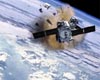 Beijing, China (XNA) Feb 19, 2009
The U.S.-Russian satellite collision not only caused a disturbance to the outer space, but also helped to arouse concern among space explorers about such accidents. The whole world has been reflecting on the inefficiency of existing space surveillance systems and has been calling for the introduction of new "space traffic regulations." |
|
|

| The content herein, unless otherwise known to be public domain, are Copyright 1995-2007 - SpaceDaily.AFP and UPI Wire Stories are copyright Agence France-Presse and United Press International. ESA Portal Reports are copyright European Space Agency. All NASA sourced material is public domain. Additional copyrights may apply in whole or part to other bona fide parties. Advertising does not imply endorsement,agreement or approval of any opinions, statements or information provided by SpaceDaily on any Web page published or hosted by SpaceDaily. Privacy Statement |
 del.icio.us
 Digg
Digg Reddit
 YahooMyWeb
 Google
 Facebook