
 |
 |
 |
 |
 |
 |
 |
 |
 |

 |
Satellite collision raises concern over space traffic, debris
Paris (AFP) Feb 12, 2009 An unprecedented collision between a Russian and US satellite will fuel concern over the lack of traffic controls in space and the rising volumes of junk that endanger vital satellites and manned flight. A disused Russian military satellite, Cosmos 2251, collided on Tuesday with a US communications satellite owned by the Iridium company, some 800 kilometers (500 miles) above the Earth, Russian officials said. The incident raises grave questions over how it was allowed to happen and what will become of the cloud of orbital debris, which adds to one of the biggest headaches in space, experts say. Philippe Goudy, deputy director of France's space centre in Toulouse, explained that more than 50 years after the start of the space age there is still no globally recognised arrangements for orbital tracks, as there are flight paths for aircraft. "The US army and NASA have radars that can track satellites and the biggest debris, measuring more than 10 centimetres (four inches) across," he told AFP. Before the collision, there were around 12,000 orbiting objects of this size. "Some space agencies have access to the US data and have set up a monitoring system to ensure that none of their satellites comes dangerously close to his debris." The latest incident "probably arose because of a lack of monitoring," Goudy suggested. "Satellite operators are only now becoming aware of the problem of debris. Even if the US data is available, not all of them have set up procedures to access them and act on them." Initial assessments point to only a small risk to the International Space Station and its three crew, which is orbiting on a lower trajectory of 354 kilometers (220 miles) above Earth. But many commercial, military, meteorological and navigational satellites orbit at the altitude where the collision occurred. "For satellites in this orbit it definitely creates a risk but we have to be very, very careful in not predicting a catastrophe before we have the full assessment," said Jocelyne Landeau of the European Space Operations Centre (ESOC), a branch of the European Space Agency (ESA). "The pollution is only starting," she said. "There's a first collision, the pieces fly around, and then they collide into each other and this makes smaller pieces. It takes time to assess and find out whether it represents a risk." Active satellites, the space shuttle and the ISS have thrusters to manoeuvre out of harm's way, but at the cost of using their precious fuel. Travelling at fantastic speeds, even tiny debris carries enough energy to wreck a satellite or depressurise a spacecraft worth billions of dollars. In 1996, a French spy satellite, Cerise, was hit at about 50,000 kilometers (30,000 miles) per hour by a wheeling fragment left from an exploded Ariane rocket. In June 1983, the windscreen of the US space shuttle Challenger had to be replaced after it was chipped by a fleck of paint measuring just 0.3 mm (0.01 of an inch), that impacted at four kilometres (2.5 miles) per second. Before the latest incident, there were over 300,000 orbital objects measuring between 1 and 10 centimetres (0.4 and four inches) in diameter and "billions" of smaller pieces, a watchdog group called the Space Security Index said last year. The rubbish includes micro-particles and massive fuel tanks, drifting derelict satellites, pieces from satellites or final-stage launchers that have either disintegrated in the hostile environment of space, or exploded because of residual fuel. Then there is junk from human missions, including a golf ball, whacked into orbit in a stunt by the ISS, and a tool kit, lost by astronaut Heidemarie Stefanyshyn-Piper in a spacewalk last November. The worst debris clouds are in low Earth orbit (LEO), between 800 and 1,500 kilometers (500 and 950 miles) above the Earth, and in geostationary orbit, about 35,000 kilometres (22,000 miles) up. In January 2007, China tested an anti-satellite weapon, destroying a disused Chinese weather satellite, the Fengyun-1C, and unleashing fierce protests from within the space community. At a stroke, the test created the largest man-made debris field in history, comprising 2,378 fragments greater than five centimetres (two inches) across that "remains pervasive throughout low Earth orbit," NASA said last month in its quarterly publication, Orbital News. "Less than two percent of the catalogued debris have fallen back to Earth," NASA said. "Many of the debris will stay in orbit for decades and some for more than a century." Share This Article With Planet Earth
Related Links Space Technology News - Applications and Research
 Satellite collision threatens space assets
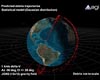 Washington (AFP) Feb 12, 2009
A Russian and a US satellite crashed into each other in an unprecedented collision unleashing clouds of space debris that could threaten orbiting spacecraft, officials said Thursday. |
|
|

| The content herein, unless otherwise known to be public domain, are Copyright 1995-2007 - SpaceDaily.AFP and UPI Wire Stories are copyright Agence France-Presse and United Press International. ESA Portal Reports are copyright European Space Agency. All NASA sourced material is public domain. Additional copyrights may apply in whole or part to other bona fide parties. Advertising does not imply endorsement,agreement or approval of any opinions, statements or information provided by SpaceDaily on any Web page published or hosted by SpaceDaily. Privacy Statement |
 del.icio.us
 Digg
Digg Reddit
 YahooMyWeb
 Google
 Facebook