
 |
 |
 |
 |
 |
 |
 |
 |
 |

 |
Satellite collision threatens space assets
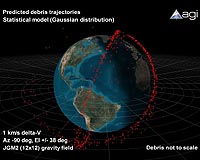
Washington (AFP) Feb 12, 2009 A Russian and a US satellite crashed into each other in an unprecedented collision unleashing clouds of space debris that could threaten orbiting spacecraft, officials said Thursday. A disused Russian military satellite, Kosmos 2251, collided on Tuesday at 1655 GMT with a communications satellite owned by US-based Iridium Satellite LLC, Russian and US space officials said. The accident took place about 500 miles (800 kilometers) above Siberia, said Russia's Major General Alexander Yakushin, quoted by the Interfax news agency. After more than five decades of human activity in space, the news raises fresh concern over the swarms of hazardous debris orbiting the Earth. The magnitude of the two large debris clouds from the collision, the first hypervelocity impact between two intact spacecraft, will not be known for at least several weeks, NASA said. "So far, NASA experts have determined that the risk to the Space Station is elevated. They estimate the risk to be very small and within acceptable limits," John Yembrick, a spokesman for the US space agency, told AFP. "Although a small amount of debris will pass through the station's altitude, some over months, some over years, some over decades, we can track them and, in a worst case scenario, dodge the debris if necessary." The International Space Station (ISS) orbits about 220 miles (354 kilometers) above the Earth, far below the point of collision. But NASA's Hubble Space Telescope and Earth observation satellites travel at higher orbits and could face a greater risk of damage. "NASA's Earth-observing satellites orbit at an altitude of approximately 439 miles (707 kilometers), which is not far from the 491-mile (790-kilometer) altitude of the collision. They are of the highest concern as NASA learns more about the newly-created debris field," Yembrick said. Although "all satellites operating in or passing through low-Earth orbit potentially are at risk of being impacted, including at least 20 NASA satellites, the risk is considered very low," he added. Yembrick said the risk to NASA assets, "considered small," depends on the spacecraft's size and distance. The Pentagon meanwhile acknowledged it had not anticipated the accident, citing "limits" on the ability to track thousands of man-made objects in space. The debris from the defunct 1,984-pound (900-kilogram) Russian satellite launched in 1993, and its 1,235-pound (560-kilogram) US counterpart could be significant. "We are looking at around more than 500 pieces of debris," said Navy Lieutenant Charlie Drey, a spokesman with US Strategic Command (STRATCOM), whose Joint Space Operations Center tracks and catalogs over 18,000 man-made objects orbiting the Earth. "Anytime you have something like this happen, there is a concern about other objects that are in orbit. Now that you have all this debris there, it does pose a risk to satellites," he told AFP. Analysts are plotting the coordinates of each of the debris pieces, which will later be posted on the website space-track.org. In a statement, Iridium called the crash an "extremely unusual, very low-probability event," adding it has 66 communication satellites in orbit and rejecting any fault for the accident. NASA spokesman William Jeffs said there was no danger to the scheduled launch of the space shuttle Discovery to the ISS due February 22. Before the latest incident, there were over 300,000 orbital objects measuring between 0.4 and four inches (one and 10 centimeters) in diameter and "billions" of smaller pieces, according to a 2008 report by the Space Security Index, an international monitoring group. Traveling at speeds that can reach many thousands of miles (kilometers) per hour, the tiniest debris orbiting can damage or destroy a spacecraft. In June 1983, the windscreen of the US space shuttle Challenger had to be replaced after it was chipped by a fleck of paint measuring 0.01 of an inch (0.3 millimeters) that impacted at 2.5 miles (four kilometers) per second. Some 6,000 satellites have been sent into space since the Soviet Union launched the first man-made orbiter, Sputnik 1, in 1957. About 800 satellites remain in operation, according to STRATCOM. NASA's World Book says there are about 3,000 "useful" satellites, without providing details. Share This Article With Planet Earth
Related Links Space Technology News - Applications and Research
 When Satellites Collide
 Bethesda MD (SPX) Feb 11, 2009
We have been speculating that pieces of space debris occasionally hit active satellites, but we had no concrete evidence to confirm such a hypothesis. |
|
|

| The content herein, unless otherwise known to be public domain, are Copyright 1995-2007 - SpaceDaily.AFP and UPI Wire Stories are copyright Agence France-Presse and United Press International. ESA Portal Reports are copyright European Space Agency. All NASA sourced material is public domain. Additional copyrights may apply in whole or part to other bona fide parties. Advertising does not imply endorsement,agreement or approval of any opinions, statements or information provided by SpaceDaily on any Web page published or hosted by SpaceDaily. Privacy Statement |
 del.icio.us
 Digg
Digg Reddit
 YahooMyWeb
 Google
 Facebook