
 |
 |
 |
 |
 |
 |
 |
 |
 |

 |
Satellites Show Arctic Literally On Thin Ice
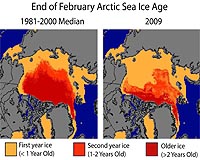
Greenbelt MD (SPX) Apr 08, 2009 The latest Arctic sea ice data from NASA and the National Snow and Ice Data Center show that the decade-long trend of shrinking sea ice cover is continuing. New evidence from satellite observations also shows that the ice cap is thinning as well. Arctic sea ice works like an air conditioner for the global climate system. Ice naturally cools air and water masses, plays a key role in ocean circulation, and reflects solar radiation back into space. In recent years, Arctic sea ice has been declining at a surprising rate. Scientists who track Arctic sea ice cover from space announced that this winter had the fifth lowest maximum ice extent on record. The six lowest maximum events since satellite monitoring began in 1979 have all occurred in the past six years (2004-2009). Until recently, the majority of Arctic sea ice survived at least one summer and often several. But things have changed dramatically, according to a team of University of Colorado, Boulder, scientists led by Charles Fowler. Thin seasonal ice - ice that melts and re-freezes every year - makes up about 70 percent of the Arctic sea ice in wintertime, up from 40 to 50 percent in the 1980s and 1990s. Thicker ice, which survives two or more years, now comprises just 10 percent of wintertime ice cover, down from 30 to 40 percent. According to researchers from the National Snow and Ice Data Center in Boulder, Colo., the maximum sea ice extent for 2008-09, reached on Feb. 28, was 5.85 million square miles. That is 278,000 square miles less than the average extent for 1979 to 2000. "Ice extent is an important measure of the health of the Arctic, but it only gives us a two-dimensional view of the ice cover," said Walter Meier, research scientist at the center and the University of Colorado, Boulder. "Thickness is important, especially in the winter, because it is the best overall indicator of the health of the ice cover. As the ice cover in the Arctic grows thinner, it grows more vulnerable to melting in the summer." The Arctic ice cap grows each winter as the sun sets for several months and intense cold sets in. Some of that ice is naturally pushed out of the Arctic by winds, while much of it melts in place during summer. The thicker, older ice that survives one or more summers is more likely to persist through the next summer. Sea ice thickness has been hard to measure directly, so scientists have typically used estimates of ice age to approximate its thickness. But last year a team of researchers led by Ron Kwok of NASA's Jet Propulsion Laboratory in Pasadena, Calif., produced the first map of sea ice thickness over the entire Arctic basin. Using two years of data from NASA's Ice, Cloud, and land Elevation Satellite (ICESat), Kwok's team estimated thickness and volume of the Arctic Ocean ice cover for 2005 and 2006. They found that the average winter volume of Arctic sea ice contained enough water to fill Lake Michigan and Lake Superior combined. The older, thicker sea ice is declining and is being replaced with newer, thinner ice that is more vulnerable to summer melt, according to Kwok. His team found that seasonal sea ice averages about 6 feet in thickness, while ice that had lasted through more than one summer averages about 9 feet, though it can grow much thicker in some locations near the coast. Kwok is currently working to extend the ICESat estimate further, from 2003 to 2008, to see how the recent decline in the area covered by sea ice is mirrored in changes in its volume. "With these new data on both the area and thickness of Arctic sea ice, we will be able to better understand the sensitivity and vulnerability of the ice cover to changes in climate," Kwok said. Share This Article With Planet Earth
Related Links ICESat Earth Observation News - Suppiliers, Technology and Application
 NASA Goddard Orders Second Instrument For GPM Mission
 Greenbelt MD (SPX) Apr 08, 2009
NASA's Goddard Space Flight Center, Greenbelt, Md., has ordered a second instrument for the agency's Global Precipitation Measurement (GPM) mission. |
|
|

| The content herein, unless otherwise known to be public domain, are Copyright 1995-2007 - SpaceDaily.AFP and UPI Wire Stories are copyright Agence France-Presse and United Press International. ESA Portal Reports are copyright European Space Agency. All NASA sourced material is public domain. Additional copyrights may apply in whole or part to other bona fide parties. Advertising does not imply endorsement,agreement or approval of any opinions, statements or information provided by SpaceDaily on any Web page published or hosted by SpaceDaily. Privacy Statement |
 del.icio.us
 Digg
Digg Reddit
 YahooMyWeb
 Google
 Facebook