
 |
 |
 |
 |
 |
 |
 |
 |
 |

 |
SciSys Software Sees Cyber Model Of GOCE Turn Into Orbital Model
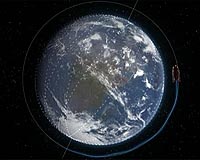
Reading, UK (SPX) Mar 19, 2009 The European Space Agency (ESA) has launched the most sophisticated mission ever to investigate the Earth's gravitational field and to map the reference shape of our planet - the geoid - with unprecedented resolution and accuracy. The launch was applauded by staff at SciSys' offices in the UK and Germany where they have been responsible for the design and implementation of the mission's critical operational simulator. The Gravity field and steady-state Ocean Circulation Explorer (GOCE) was placed into a low altitude near sun-synchronous orbit by a Rockot vehicle launched from Russia on Tuesday 17 March. Data collected from the satellite will provide a high-resolution map of the geoid and any gravitational anomalies. This will greatly improve our knowledge and understanding of the Earth's internal structure and will also be used as a much better reference for ocean and climate studies, including sea-level changes, oceanic circulation and ice cap dynamics. The simulator - which makes use of ESA's software simulation kernel called SIMSAT - is a fully representative software model of the satellite and its payload and plays a number of important roles across the lifetime of the GOCE mission. Dick van der Zee, SciSys Project Manager for the simulator commented "spacecraft control is critical for any mission and so a simulator is used to train the mission control team before launch in how best to handle the satellite. GOCE is particularly challenging since it orbits at an exceptionally low altitude of just 268 km, resulting in very short ground station passes. "Our team has supported a number of full-day and back-to-back simulations and I am pleased that our software worked flawlessly". The simulator will continue to be used after launch for routine training and to validate contingency operations in the event of anomalies. SciSys will continue to be involved in the maintenance of the simulator to support its use. The GOCE simulator continues a successful involvement of SciSys in all of ESA's Earth Explorer Core Missions. SciSys is developing software systems for ADM-Aeolus for atmospheric dynamics (2010), and EarthCARE to investigate the Earth's radiative balance (2013). Three Earth Explorer Opportunity Missions will also include software developed by SciSys. These are Cryosat 2 to measure ice sheet thickness (2009), SMOS to study soil moisture and ocean salinity (2009) and Swarm to survey the evolution of the magnetic field (2010). Share This Article With Planet Earth
Related Links SciSys Earth Observation News - Suppiliers, Technology and Application
 New Aerosol Observing Technique Turns Gray Skies To Blue
 Washington DC (SPX) Mar 18, 2009
Tiny, ubiquitous particles in the atmosphere may play a profound role in regulating global climate. But the scientists who study these particles - called aerosols - have long struggled to accurately measure their composition, size, and global distribution. |
|
|

| The content herein, unless otherwise known to be public domain, are Copyright 1995-2007 - SpaceDaily.AFP and UPI Wire Stories are copyright Agence France-Presse and United Press International. ESA Portal Reports are copyright European Space Agency. All NASA sourced material is public domain. Additional copyrights may apply in whole or part to other bona fide parties. Advertising does not imply endorsement,agreement or approval of any opinions, statements or information provided by SpaceDaily on any Web page published or hosted by SpaceDaily. Privacy Statement |
 del.icio.us
 Digg
Digg Reddit
 YahooMyWeb
 Google
 Facebook