
 |
 |
 |
 |
 |
 |
 |
 |
 |

 |
Scientist Says Tie Up Asteroids To Protect Earth From Strike
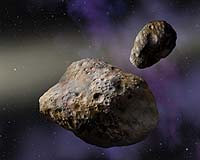
Moscow (RIA Novosti) Apr 20, 2009 If an asteroid is on a collision course with Earth, the best way to avoid a global catastrophe could be to attach a long tether with a weight at the end to deflect its orbit, a U.S. scientist has suggested. David French, a doctoral candidate in aerospace engineering at North Carolina State University, said that by attaching ballast and a tether to asteroids "you change the object's center of mass, effectively changing the object's orbit and allowing it to pass by the Earth, rather than impacting it." NASA has identified over 1,000 of potentially dangerous objects nearing the Earth, and the number is growing. "While none of these objects is currently projected to hit Earth in the near future, slight changes in the orbits of these bodies, which could be caused by the gravitational pull of other objects, push from the solar wind, or some other effect could cause an intersection," French said. French said that while his solution sounds far-fetched, it compares favorably with other methods, which include painting the asteroid to change the effect sunlight has on its orbit or using nuclear weapons. Share This Article With Planet Earth
Related Links - Asteroid and Comet Impact Danger To Earth - News and Science
 Experts To Discuss Dangers And Legal Issues Thwarting Near-Earth Objects
 Superior CO (SPX) Apr 16, 2009
A unique forum of experts from around the world is set to examine the dangers, prospects and legal issues of dealing with menacing Near-Earth Objects (NEOs). |
|
|

| The content herein, unless otherwise known to be public domain, are Copyright 1995-2007 - SpaceDaily.AFP and UPI Wire Stories are copyright Agence France-Presse and United Press International. ESA Portal Reports are copyright European Space Agency. All NASA sourced material is public domain. Additional copyrights may apply in whole or part to other bona fide parties. Advertising does not imply endorsement,agreement or approval of any opinions, statements or information provided by SpaceDaily on any Web page published or hosted by SpaceDaily. Privacy Statement |
 del.icio.us
 Digg
Digg Reddit
 YahooMyWeb
 Google
 Facebook