
 |
 |
 |
 |
 |
 |
 |
 |
 |

 |
Scientists Inaugurate World's Largest Cosmic-Ray Observatory
Malargue, Argentina (SPX) Nov 14, 2008 Scientists of the Pierre Auger Observatory, a project to study the highest-energy cosmic rays, will celebrate the inauguration of their 3000-square-kilometer detector array at the southern site of the observatory in Malargue, Argentina, this Friday, November 14, 2008. The event will mark the completion of the first phase of the observatory construction and the beginning of the project's second phase, which includes plans for a northern hemisphere site in Colorado, USA, and enhancements to the southern hemisphere site. The inauguration celebration in Argentina will begin with an informal reception on November 13. A symposium on Friday, November 14, will include presentations on the origins of the project, the construction of the experiment and the latest science results. The Pierre Auger Observatory is exploring the mysteries of the highest-energy cosmic rays-charged particles showering the Earth at energies 10 million times higher than the world's highest-energy particle accelerator. Until now, there has been no consensus on the origin of these highest-energy cosmic rays. To witness these extremely rare events, the Pierre Auger Collaboration began the construction of its Southern Observatory in the year 2000. The project consists of an array of 1600 detectors spread over 3000 square kilometers in Argentina's Mendoza Province, just east of the Andes Mountains. Surrounding the array is a set of 24 fluorescence telescopes that view the faint ultraviolet light emitted by the cosmic-ray shower particles as they cascade through the atmosphere. More than 40 funding agencies are contributing to the observatory, which had a construction cost of approximately $53 million. The Pierre Auger collaboration published its first physics results in the fall of 2007, revealing new insights into the properties of the highest-energy particles in the universe. The collaboration found that the arrival directions of the highest-energy cosmic rays are anisotropic. The arrival directions correlate with the distribution of nearby galaxies that contain actively radiating black holes. Several science organizations selected this remarkable result as one of the most important scientific breakthroughs in 2007. The collaboration used its growing detector array to measure the cosmic-ray energy spectrum at the highest energies, achieving higher precision than any previous experiment. The Auger scientists found a fall-off of the flux at the highest energies. This is consistent with an idea, proposed about 40 years ago, that high-energy cosmic rays interact with photons of the ubiquitous microwave background radiation on their way through the universe. New limits on the photon and neutrino content in cosmic rays have put stringent limits on theories of cosmic-ray origins. Share This Article With Planet Earth
Related Links Pierre Auger collaboration Space Telescope News and Technology at Skynightly.com
 Submillimetre Eagle Eyes On Mauna Kea
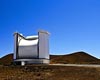 Mauna Kea HI (SPX) Nov 14, 2008
Three observatories on Mauna Kea have come together to form the world's most powerful facility for detailed submillimetre imaging. An exploratory project, the Extended SubMillimeter Array (eSMA) connects the signals from the SubMillimeter Array (SMA), consisting of eight dishes with 6-metre diameter, with those from the 15-metre James Clerk Maxwell Telescope (JCMT) and the 10-metre Caltech Submillimeter Observatory (CSO) through fibre-optic cables. |
|
|

| The content herein, unless otherwise known to be public domain, are Copyright 1995-2007 - SpaceDaily.AFP and UPI Wire Stories are copyright Agence France-Presse and United Press International. ESA Portal Reports are copyright European Space Agency. All NASA sourced material is public domain. Additional copyrights may apply in whole or part to other bona fide parties. Advertising does not imply endorsement,agreement or approval of any opinions, statements or information provided by SpaceDaily on any Web page published or hosted by SpaceDaily. Privacy Statement |
 del.icio.us
 Digg
Digg Reddit
 YahooMyWeb
 Google
 Facebook