
 |
 |
 |
 |
 |
 |
 |
 |
 |

 |
Scientists Optimize New ISS Water System
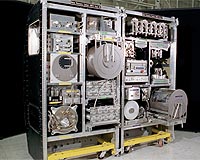
Houghton MI (SPX) Nov 18, 2008 Two hundred and fifty miles above the Earth puts you a long way from the nearest kitchen tap. And at $10,000 a pint, the cost of shipping fresh water aboard the space shuttle is, well, astronomical. So astronauts on the International Space Station have to recapture every possible drop. That includes water evaporated from showers, shaving, tooth brushing and hand washing, plus perspiration and water vapor that collects within the astronauts' space suits. They even transfer water from the fuel cells that provide electric power to the space shuttle. Until now, however, NASA has not attempted to tap one major potential source of water: urine. That will soon change with the deployment of the new Water Recovery System. It departs Friday, Nov. 14, from the Kennedy Space Center on the Space Shuttle Endeavor. The Water Recovery System, made possible in part by researchers at Michigan Technological University, can transform ordinary pee into water so pure it rivals the cleanest on Earth. David Hand was the lead researcher on the project, which ran from 1993 to 1997 at Tech. It was a memorable time. "We received jars of sweat from NASA," he said. "Then we did experiments on the system, measured it at every step, evaluated it and made recommendations." Under the new system, urine undergoes an initial distillation process and then joins the rest of the recovered fluids in the water processor. The processor filters out solids such as hair and lint and then sends the wastewater through a series of multifiltration beds, in which contaminants are removed through adsorption and ion exchange. "What's left over in the water are a few non adsorbing organics and solvents, like nail polish remover, and they go into a reactor that breaks them all down to carbon dioxide, water and a few ions," said Hand, a professor of civil and environmental engineering. After a final check for microbes, the water is again clean and ready to drink. NASA's Layne Carter, the Water Recovery System lead engineer at Marshall Spaceflight Center in Huntsville, Ala., credits Hand and the rest of the Tech research team with making the system as good as it is. "Without a doubt, if it hadn't been for their modeling effort, we never would have been able to redesign the multifiltration beds and achieve that level of efficiency," Carter said. "They did a fantastic job." Using mathematical models, the Tech researchers helped improve the overall design of the multifiltration beds, The redesigned beds have 30 percent more capacity, which means that NASA doesn't have to send about 60 pounds of additional supplies up to the space station annually. "That may seem trivial, but it saves NASA about $600,000 each year," Carter said. Share This Article With Planet Earth
Related Links Water Recovery System Michigan Technological University Station at NASA Station and More at Roscosmos S.P. Korolev RSC Energia Watch NASA TV via Space.TV Space Station News at Space-Travel.Com
 Expedition 17 Set To Undock Today
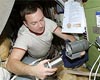 Houston TX (SPX) Oct 24, 2008
With the Expedition 18 crew officially in command of the International Space Station, the Expedition 17 crew has finished making its final departure preparations and is ready to return to Earth. Outgoing commander Sergei Volkov officially handed over control of the station to new commander Mike Fincke Wednesday afternoon. |
|
|

| The content herein, unless otherwise known to be public domain, are Copyright 1995-2007 - SpaceDaily.AFP and UPI Wire Stories are copyright Agence France-Presse and United Press International. ESA Portal Reports are copyright European Space Agency. All NASA sourced material is public domain. Additional copyrights may apply in whole or part to other bona fide parties. Advertising does not imply endorsement,agreement or approval of any opinions, statements or information provided by SpaceDaily on any Web page published or hosted by SpaceDaily. Privacy Statement |
 del.icio.us
 Digg
Digg Reddit
 YahooMyWeb
 Google
 Facebook