
 |
 |
 |
 |
 |
 |
 |
 |
 |

 |
Scientists Pinpoint The Edge Of Space
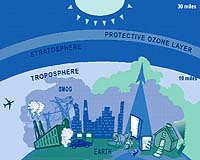
Calgary, Canada (SPX) Apr 16, 2009 Where does space begin? Scientists at the University of Calgary have created a new instrument that is able to track the transition between the relatively gentle winds of Earth's atmosphere and the more violent flows of charged particles in space - flows that can reach speeds well over 1000 km/hr. And they have accomplished this in unprecedented detail. Data received from the U of C-designed instrument sent to space on a NASA launch from Alaska about two years ago was able to help pinpoint the so-called edge of space: the boundary between the Earth's atmosphere and outer space. With that data, U of C scientists confirmed that space begins 118 km above Earth and the results were published this week in the Journal of Geophysical Research. The instrument - called the Supra-Thermal Ion Imager - was carried by the JOULE-II rocket on Jan. 19, 2007. It travelled to an altitude of about 200 kilometers above sea level and collected data for the five minutes it was moving through the "edge of space." The Canadian Space Agency invested $422,000 in the development of the Supra-Thermal Ion Imager instrument on JOULE-II. The ability to gather data in that area is significant because it's very difficult to make measurements in this region, which is too high for balloons and too low for satellites. "It's only the second time that direct measurements of charged particle flows have been made in this region, and the first time all the ingredients - such as the upper atmospheric winds - have been included," says David Knudsen, associate professor in the Department of Physics and Astronomy at the University of Calgary. Knudsen and his former PhD student Laureline Sangalli are the lead authors of the paper. Co-authors include: JOULE-II lead scientist Miguel Larsen of Clemson University, Robert Pfaff and Douglas Rowland of NASA Goddard Space Flight Center and T. Zhan of Conseco Inc. "When you drag a heavy object over a surface, the interface becomes hot. In JOULE-II we were able to measure directly two regions being dragged past each other, one being the ionosphere - being driven by flows in space - and the other the earth's atmosphere," says Knudsen, who also is the head of the Space Physics Division of the Institute for Space Imaging Sciences (ISIS). The institute is a research partnership between the University of Calgary and University of Lethbridge. The measurements confirmed what other scientists consider the boundary or edge of space. "The results have given us a closer look at space, which is a benefit to pure research in space science," Knudsen says. "But it also allows us to calculate energy flows into the Earth's atmosphere that ultimately may be able to help us understand the interaction between space and our environment. That could mean a greater understanding of the link between sunspots and the warming and cooling of the Earth's climate as well as how space weather impacts satellites, communications, navigation, and power systems." The U of C-designed instrument has been adopted by COM DEV, an Ontario-based global designer and manufacturer of space hardware, and is being used as a prototype for three instruments currently being readied to fly on the European Space Agency's "Swarm" satellite mission, set to launch late next year and to collect data for four years. The JOULE-II instrument is one in a long list of more than a dozen instruments designed by U of C scientists in the past forty years which have flown in space. There are at least five more being readied to go on missions in the next two years. "Understanding the boundary between the Earth's atmosphere and outer space is fundamental to the bigger picture of the effects of space on the Earth's climate and environment," says Russ Taylor, the director of ISIS and head of the Department of Physics and Astronomy at the U of C. "This detection is part of a long history of success by ISIS researchers in designing and building innovative instruments flown on rockets and satellites to image the flow of matter and energy between the Earth and Space." The paper "Rocket-based measurements of ion velocity, neutral wind, and electric field in the collisional transition region of the auroral ionosphere" was published this week in the Journal of Geophysical Research. It can be found on-line. Share This Article With Planet Earth
Related Links University of Calgary Space Tourism, Space Transport and Space Exploration News
 Kazakhstan Indefinitely Postpones Space Program Indefinitely
 Almaty (XNA) Apr 16, 2009
Kazakhstan has indefinitely postponed a plan of sending its own cosmonaut to the International Space Station (ISS) for lack of funding, Talgat Musabayev, head of the National Space Agency, said on Thursday. |
|
|

| The content herein, unless otherwise known to be public domain, are Copyright 1995-2007 - SpaceDaily.AFP and UPI Wire Stories are copyright Agence France-Presse and United Press International. ESA Portal Reports are copyright European Space Agency. All NASA sourced material is public domain. Additional copyrights may apply in whole or part to other bona fide parties. Advertising does not imply endorsement,agreement or approval of any opinions, statements or information provided by SpaceDaily on any Web page published or hosted by SpaceDaily. Privacy Statement |
 del.icio.us
 Digg
Digg Reddit
 YahooMyWeb
 Google
 Facebook