
 |
 |
 |
 |
 |
 |
 |
 |
 |

 |
Scientists Prove Graphene's Edge Structure Affects Electronic Properties
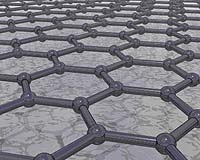
Champaign IL (SPX) Feb 18, 2009 Graphene, a single-atom-thick sheet of carbon, holds remarkable promise for future nanoelectronics applications. Whether graphene actually cuts it in industry, however, depends upon how graphene is cut, say researchers at the University of Illinois. Graphene consists of a hexagonal lattice of carbon atoms. While scientists have predicted that the orientation of atoms along the edges of the lattice would affect the material's electronic properties, the prediction had not been proven experimentally. Now, researchers at the U. of I. say they have proof. "Our experimental results show, without a doubt, that the crystallographic orientation of the graphene edges significantly influences the electronic properties," said Joseph Lyding, a professor electrical and computer engineering. "To utilize nanometer-size pieces of graphene in future nanoelectronics, atomically precise control of the geometry of these structures will be required." Lyding and graduate student Kyle Ritter (now at Micron Technology Inc. in Boise, Idaho) report their findings in a paper accepted for publication in Nature Materials. The paper is to be posted on the journal's Web site. To carry out their work, the researchers developed a method for cutting and depositing nanometer-size bits of graphene on atomically clean semiconductor surfaces like silicon. Then they used a scanning tunneling microscope to probe the electronic structure of the graphene with atomic-scale resolution. "From this emerged a clear picture that edges with so-called zigzag orientation exhibited a strong edge state, whereas edges with armchair orientation did not," said Lyding, who also is affiliated with the university's Beckman Institute and the Micro and Nanotechnology Laboratory. "We found that pieces of graphene smaller than about 10 nanometers with predominately zigzag edges exhibited metallic behavior rather than the semiconducting behavior expected from size alone," Lyding said. "This has major implications in that semiconducting behavior is mandatory for transistor fabrication." Unlike carbon nanotubes, graphene is a flat sheet, and therefore compatible with conventional fabrication processes used by today's chipmakers. But, based on the researchers' experimental results, controlled engineering of the graphene edge structure will be required for obtaining uniform performance among graphene-based nanoelectronic devices. "Even a tiny section of zigzag orientation on a 5-nanometer piece of graphene will change the material from a semiconductor into a metal," Lyding said. "And a transistor based on that, will not work. Period." Share This Article With Planet Earth
Related Links University of Illinois at Urbana-Champaign Nano Technology News From SpaceMart.com Computer Chip Architecture, Technology and Manufacture
 Nanoparticle Toxicity Doesn't Get Wacky At The Smallest Sizes
 Chicago IL (SPX) Feb 18, 2009
The smallest nano-sized silica particles used in biomedicine and engineering likely won't cause unexpected biological responses due to their size. The result should allay fears that cells and tissues will react unpredictably when exposed to the finest silica nanomaterials in industrial or commercial applications. |
|
|

| The content herein, unless otherwise known to be public domain, are Copyright 1995-2007 - SpaceDaily.AFP and UPI Wire Stories are copyright Agence France-Presse and United Press International. ESA Portal Reports are copyright European Space Agency. All NASA sourced material is public domain. Additional copyrights may apply in whole or part to other bona fide parties. Advertising does not imply endorsement,agreement or approval of any opinions, statements or information provided by SpaceDaily on any Web page published or hosted by SpaceDaily. Privacy Statement |
 del.icio.us
 Digg
Digg Reddit
 YahooMyWeb
 Google
 Facebook