
 |
 |
 |
 |
 |
 |
 |
 |
 |

 |

Queensland, Australia (SPX) Jul 28, 2010 An international team of scientists has been exploring Moreton Bay, close to Brisbane, as a possible 'lifeboat' to save corals from the Great Barrier Reef at risk of extermination under climate change. In a new research paper they say that corals have been able to survive and flourish in the Bay, which lies well to the south of the main GBR coral zones, during about half of the past 7000 years. Corals only cover about 1 per cent of the Moreton Bay area currently, and have clearly been adversely affected by clearing of the surrounding catchments and human activities on land and sea, says lead author Matt Lybolt of the ARC Centre of Excellence for Coral Reef Studies and The University of Queensland. "The demise of tropical coral reefs around the world is due mainly to overfishing, pollution and climate change. There is also plenty of historical evidence that coral reefs can move from one environment to another as the climate and other conditions change," Matt explains. "In view of this, various places - including Moreton Bay - are being investigated as possible refuges in which coral systems can be preserved should they begin to die out in their natural settings. Indeed, some people have even talked of relocating and re-seeding corals in other locations that better suit their climatic needs." The team's study of Moreton Bay reveals that it is not exactly ideal coral habitat, being cold in winter, lacking sufficient direct sunlight, subject to turbid freshwater inflows and - more recently - to a range of human impacts. "Even before European settlers came on the scene the Bay underwent phases in which corals grew prolifically - and phases in which they died away almost completely. We understand what causes corals to die back, but we are less clear about what causes them to recover," Matt says. "Broadly, the corals seemed to do well at times when the climate, sea levels and other factors were most benign and stable - and to decline when El Nino and other disturbances made themselves felt." The Moreton Bay corals have been in an expansionary phase during the last 400 years, initially dominated by the branching Acropora corals but, since the Bay's catchment was cleared and settled, these have died back leaving mainly slow-growing types of coral. "Under climate change we expect winters to be warmer and sea levels to rise - and both of these factors will tend to favour the expansion of corals in Moreton Bay," Matt says. "However this expansion of corals may not occur unless we make a major effort to improve water quality in the Bay, by not allowing effluent, polluted runoff or sediment to enter it, and also by regrowing mangrove forests and seagrass beds within the Bay. " The team concludes that Moreton Bay's potential as a good 'lifeboat' for corals is limited by four major factors: + It is highly sensitive to what the 2 million residents of its catchment do that affects it + It presently has very few branching corals left + The area on which corals can grow is limited, both naturally and by human activity + Finally, the historical record suggests the Bay is only a good coral refuge about half of the time. Matt says that there is nevertheless scope for changes in the management of the Bay and its surrounding catchments that can improve its suitability as a coral environment. "The reefs of today don't look anything like they did in the past, so it's really a question of 'What sort of coral reef do you want?'," he says. However there needs to be a clearer scientific understanding of the drivers that have caused corals to boom and bust within the Bay over the past seven millennia before we can be sure it is worthwhile attempting to make Moreton Bay a 'lifeboat' for the GBR, he cautions. Matt noted that there are very few suitable coral habitats south of the southern end of the GBR to which corals can migrate, should the northern parts of the reef become untenable for corals due to the impact of global warming. Their paper "Instability in a marginal coral reef: the shift from natural variability to a human-dominated seascape" by Matt Lybolt, David Neil, Jian-xin Zhao, Yue-xing Feng, Ke-Fu Yu and John Pandolfi appears in the latest issue of the journal Frontiers in Ecology and Environment.
Share This Article With Planet Earth
Related Links ARC Centre of Excellence for Coral Reef Studies Darwin Today At TerraDaily.com

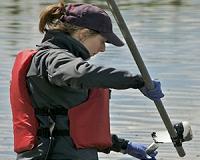 Sampling Microbial Muck
Moffett Field CA (SPX) Jul 28, 2010 On my last day with folks from PLRP, I went on a road trip to the Cariboo Plateau lakes with Allyson Brady, the acting principal investigator for PLRP 2010; Eric Collins, a post-doctoral fellow; and Jennifer Hansen, a laboratory assistant. All three are or have been connected with Greg Slater's group at McMaster University. Slater, who has been a leading member of the PLRP team for several ... read more |
|
|
| The content herein, unless otherwise known to be public domain, are Copyright 1995-2010 - SpaceDaily. AFP and UPI Wire Stories are copyright Agence France-Presse and United Press International. ESA Portal Reports are copyright European Space Agency. All NASA sourced material is public domain. Additional copyrights may apply in whole or part to other bona fide parties. Advertising does not imply endorsement,agreement or approval of any opinions, statements or information provided by SpaceDaily on any Web page published or hosted by SpaceDaily. Privacy Statement |


 del.icio.us
 Digg
Digg Reddit
 YahooMyWeb
 Google
 Facebook


