
 |
 |
 |
 |
 |
 |
 |
 |
 |

 |
Scientists find most Earth-like exoplanet ever: study
Paris (AFP) April 21, 2009 Astronomers unveiled Tuesday the lightest exoplanet ever detected and, in the same distant solar system, the first "serious candidate" for a world with abundant liquid water, both conditions essential for supporting life. "I would put the two discoveries on an equal footing," said Thierry Forveille, an astronomer at the Grenoble Observatory in France and a co-author of the study. "The holy grail of exoplanet research is to find a planet that combines both, the approximate mass of Earth and conditions favourable for water. Here we have each separately, but we are getting closer," he told AFP by phone. The newly detected smaller body, dubbed Gliese 581 "e", has a mass only twice that of Earth. This makes it the smallest of the nearly 350 exoplanets found so far, and means it probably has a rocky surface not unlike our own. Beyond a certain size, exoplanets become giant balls of toxic gas, similar to Jupiter. Nearby Gliese 581 "d" is seven times heavier than our planet, and the composition of its surface is unknown. But new calculations -- made possible by the discovery of "e" -- show that the larger planet is squarely within the so-called "habitable zone," neither too far nor too close to the star around which it orbits to support life. "Gliese 581 d is probably too massive to be make only of rocky material, but we can speculate that it is an icy planet that has migrated closer to its star," said co-author Stephane Udry, a professor at Geneva University. "It could even be covered by a large and deep ocean -- it is the first serious 'waterworld' candidate," he said in a statement. With an orbit only 3.15 days long, Gliese e orbits close to its star and is almost certainly a white-hot, fiery mass. The new findings, slated for publication in the journal Astronomy and Astrophysics, were obtained using the most successful low-mass-exoplanet hunter in the world, the HARPS spectrograph attached to the 3.6-metre ESO telescope at La Silla, Chile. Gliese 581, located some 20.5 light-years distant in the constellation Libra, falls into the category of low-mass, red dwarf stars, around which low-mass planets in the habitable zone are most likely to be found. One light-year is roughly equivalent to 9.5 trillion kilometres (6 trillion miles). Distant planets, even big ones, are too small to be directly observed, and can only be detected by measuring their impact on the movement of the stars they orbit. The first exoplanet -- 51 Pegasi b -- was detected in 1995. Almost all those discovered to date are large gas giants. "It is amazing to see how far we have come since then," said lead researcher Michael Mayer, also of Geneva University. "The mass of Gliese 581 e is 80 times less than that of 51 Pegasi b," he said. Planets are formed from a disc of gas and dusty debris left over from the creation of a star. Just how long this process takes is still a matter of debate. Earth is believed to be about 4.5 billion years old, and the Sun about 100 million years older. Share This Article With Planet Earth
Related Links Lands Beyond Beyond - extra solar planets - news and science Life Beyond Earth
 Spitzer sees asteroids around dead suns
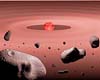 Hatfield, England, April 20, 2009
 Astronomers using the U.S. space agency's Spitzer Space Telescope say they have discovered at least one in 100 white dwarf stars has orbiting asteroids. |
|
|

| The content herein, unless otherwise known to be public domain, are Copyright 1995-2007 - SpaceDaily.AFP and UPI Wire Stories are copyright Agence France-Presse and United Press International. ESA Portal Reports are copyright European Space Agency. All NASA sourced material is public domain. Additional copyrights may apply in whole or part to other bona fide parties. Advertising does not imply endorsement,agreement or approval of any opinions, statements or information provided by SpaceDaily on any Web page published or hosted by SpaceDaily. Privacy Statement |
 del.icio.us
 Digg
Digg Reddit
 YahooMyWeb
 Google
 Facebook