
 |
 |
 |
 |
 |
 |
 |
 |
 |

 |
Scientists find new creatures of Australian deep
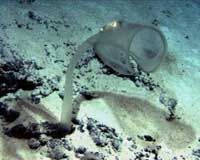
Sydney (AFP) Jan 18, 2009 Scientists said Sunday they had uncovered new marine animals in their search of previously unexplored Australian waters, along with a bizarre carnivorous sea squirt and ocean-dwelling spiders. A joint US-Australian team spent a month in deep waters off the coast of the southern island of Tasmania to "search for life deeper than any previous voyage in Australian waters," lead researcher Ron Thresher said. What they found were not only species new to science -- including previously undescribed soft corals -- but fresh indications of global warming's threat to the country's unique marine life. "Our sampling documented the deepest known Australian fauna, including a bizarre carnivorous sea squirt, sea spiders and giant sponges, and previously unknown marine communities dominated by gooseneck barnacles and millions of round, purple-spotted sea anemones," Thresher said. Using a submersible car-sized robot named Jason, the team explored a rift in the earth's crust known as the Tasman Fracture Zone, a sheer two kilometre (1.24 mile) drop to 4,000 metres (13,200 feet) below the ocean's surface. Blogging on board the ship, researcher Adam Subhas said the team witnessed some "cool biology" as they descended the fracture, including the sea squirt, which he described as "basically an underwater Venus fly trap, but much bigger." The sea squirt, also known as an ascidian, stands 50 centimetres tall on the sea floor at a depth of just over 4,000 metres. It traps prey in its funnel-like front section if they touch it when they swim past. "The geology was fascinating too -- the sediment was incredibly fine and lightly packed; it made me think of powder snow," Subhas wrote. Fossil coral fields were found, dating back more than 10,000 years. Thresher said samples taken would provide ancient climate data for use in global warming projections. "Modern-day deep-water coral reefs were also found, however, there is strong evidence that this reef system is dying, with most reef-forming coral deeper than 1,300 metres newly dead," he said. Though close analysis of samples was still required, Thresher said modelling suggested ocean acidification could be responsible. "If our analysis identifies this phenomenon as the cause of the reef system's demise, then the impact we are seeing now below 1,300 metres might extend to the shallower portions of the deep-reefs over the next 50 years, threatening this entire community," he said. Rising sea temperatures are blamed on global warming caused by the build-up in the atmosphere of greenhouse gases such as carbon dioxide -- which is also blamed for higher acidity in sea water. A UN report warned in 2007 that Australia's Great Barrier Reef, described as the world's largest living organism, could be killed by climate change within decades. The World Heritage site and major tourist attraction, stretching over more than 345,000 square kilometres (133,000 square miles) off Australia's east coast, could become "functionally extinct", the report said. Share This Article With Planet Earth
Related Links Water News - Science, Technology and Politics
 Corals Stage Dramatic Comeback Four Years After Tsunami
 New York NY (SPX) Jan 04, 2009
A team of scientists from the New York-based Wildlife Conservation Society (WCS) has reported a rapid recovery of coral reefs in areas of Indonesia, following the tsunami that devastated coastal regions throughout the Indian Ocean four years ago today. |
|
|

| The content herein, unless otherwise known to be public domain, are Copyright 1995-2007 - SpaceDaily.AFP and UPI Wire Stories are copyright Agence France-Presse and United Press International. ESA Portal Reports are copyright European Space Agency. All NASA sourced material is public domain. Additional copyrights may apply in whole or part to other bona fide parties. Advertising does not imply endorsement,agreement or approval of any opinions, statements or information provided by SpaceDaily on any Web page published or hosted by SpaceDaily. Privacy Statement |
 del.icio.us
 Digg
Digg Reddit
 YahooMyWeb
 Google
 Facebook