|
 |
 |
 |
 |
 |
 |
 |
 |

 |
Search For Extreme Organisms In Antarctica
Huntsville AL (SPX) Feb 07, 2008 In early February, NASA's Richard Hoover will lead a team of world class explorers to a remote location in Antarctica to search for unique, never-before identified microbes. NASA and its partner organizations study the potential for life in such extreme zones to help understand the limitations of life on Earth, and to prepare human explorers to search other worlds for signs of life in the universe. Within the next two decades, NASA will return humans to the lunar surface to establish a permanent presence. Expeditions to remote, extreme areas of Earth yield valuable discoveries about our planet, but also provide opportunities to test mission concepts and equipment for future planetary exploration. In the extremely hostile environment of ice covered Antarctic lakes, Hoover hopes to find a new species of "extremophile" or a hardy life form that exists and flourishes in conditions hostile to most known organisms. The expedition will be conducted in two phases with an initial mission focusing on research in the lakes and glacial ice of Schirmacher Oasis region with a fly over of the Lake Untersee region of Antarctica. Lake Untersee is a perennially ice-covered hyper-alkaline lake with the highest production of methane of any natural aquatic system on the planet Earth. The science team is interested in assessing this lake and other lakes and glacial ice in the region for microorganisms and extremophiles. Most of the bodies of our solar system are extreme environments. But we can also study environments that are hostile to life right here on here on Earth." said Dr. Richard Hoover, NASA astrobiology. "For example, Lake Untersee, the largest lake in Antarctica, is more alkaline than household bleach. If we find microorganisms in this water, it will be first time life has been found in such an environment. Even if we don't find life, it will be exciting: we will have found the first body of water on Earth with no natural aquatic life." This expedition is an international collaboration between NASA, the Arctic and Antarctic Research Institute of the Russian Federation, the Planetary Sciences Foundation, and the Tawani Foundation, a not-for-profit philanthropic foundation headquartered in Chicago, Ill. The expedition is fully funded by the Tawani Foundation. This mission is being carried out with critical support from the Antarctic Logistics Center International in Cape Town, South Africa, and is the first of two international expeditions planned in 2008. In addition to Hoover, the first team of explorers for this reconnaissance expedition includes James N. Pritzker, Tawani Foundation, Chicago, Ill., Dale Andersen, Carl Sagan Center for the Study of Life in the Universe, Mountain View, Calif., Valery Galchenko, Winogradsky Institute of Microbiology, Moscow, and Art Mortvedt, Polar Exploration, Ltd., Manley Hot Springs, Alaska. All experienced polar explorers, the team will spend between10-15 days in Antarctica as guests of the Russian Novo Research Station and the Russian Artic and Antarctic Research Institute. The full-up expedition planned for late 2008 will include a team of 12-14 researchers and educators. The team will return to the Schirmacher Oasis and will also include a focused research effort at Lake Untersee. In addition to an international science team from Russia, Austria, and the United States, the team will also include two teachers, one from a high school and another from a junior college in the Chicago area. The teachers are being included to further enhance student interest in math and science and to inspire a next generation of explorers. Community Email This Article Comment On This Article Related Links NASA's scientific contributions to the International Polar Year Marshall Space Flight Center Darwin Today At TerraDaily.com
 Freshwater Fish Invasions The Result Of Human Activity
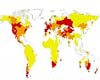 Washington DC (SPX) Feb 05, 2008
Globally, invasive species represent a major threat to native species. A new paper published this week in the open-access journal PLoS Biology shows that, for rivers and lakes, where these invasions occur is predicted by human activity; find an area where economic activity is high and, in nearby lakes and rivers, up to a quarter of species will be migrants to the region. |
|
|
| The content herein, unless otherwise known to be public domain, are Copyright Space.TV Corporation. AFP and UPI Wire Stories are copyright Agence France-Presse and United Press International. ESA Portal Reports are copyright European Space Agency. All NASA sourced material is public domain. Additional copyrights may apply in whole or part to other bona fide parties. Advertising does not imply endorsement, agreement or approval of any opinions, statements or information provided by Space.TV Corp on any Web page published or hosted by Space.TV Corp. Privacy Statement |