
 |
 |
 |
 |
 |
 |
 |
 |
 |

 |
Self-Healing Polymer May Facilitate Recycling Of Hard-To-Dispose Plastic
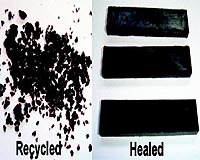
Groningen, The Netherlands (SPX) Apr 24, 2009 Researchers in The Netherlands are reporting development of a new plastic with potential for use in the first easy-to-recycle computer circuit boards, electrical insulation, and other electronics products that now wind up on society's growing heaps of electronic waste. Their study appears in ACS' Macromolecules, a bi-weekly journal. Antonius Broekhuis and colleagues note in the new study that so-called thermoset plastics are widely used in consumer electronics due to their hardness and heat resistance. These plastics, however, contain additives and reinforcement materials that make them almost impossible to recycle. So-called thermoplastics, in contrast, are softer and can be remelted easily. As a result, thermoset plastics often end up in landfills or incinerators, where they can contribute to pollution. Scientists have long-sought a simple, inexpensive process to make these plastics recyclable, but they have been largely unsuccessful until now. Broekhuis and colleagues describe development of a new type of thermosetting plastic that can be melted and remolded without losing its original heat-resistance and strength. The scientists showed in laboratory tests that they could melt granules of what they term a "self-healing" polymer and reform them into uniform, rigid plastic bars. They also showed that the plastic could be remolded multiple times, setting the stage for a new generation of recyclable plastics. "Thermally Self-Healing Polymeric Materials: The Next Step to Recycling Thermoset Polymers?" Antonius A. Broekhuis, Ph.D. Share This Article With Planet Earth
Related Links American Chemical Society Space Technology News - Applications and Research
 Metal In The Mussel That Gives Mussels Their Muscle Power
 Santa Barbara CA (SPX) Apr 14, 2009
Researchers in California are reporting for the first time that metals are key ingredients that give the coatings of anchoring byssal threads of marine mussels their amazing durability. |
|
|

| The content herein, unless otherwise known to be public domain, are Copyright 1995-2007 - SpaceDaily.AFP and UPI Wire Stories are copyright Agence France-Presse and United Press International. ESA Portal Reports are copyright European Space Agency. All NASA sourced material is public domain. Additional copyrights may apply in whole or part to other bona fide parties. Advertising does not imply endorsement,agreement or approval of any opinions, statements or information provided by SpaceDaily on any Web page published or hosted by SpaceDaily. Privacy Statement |
 del.icio.us
 Digg
Digg Reddit
 YahooMyWeb
 Google
 Facebook