
 |
 |
 |
 |
 |
 |
 |
 |
 |

 |
Sentience Technology Reveals Fuel Savings Potential
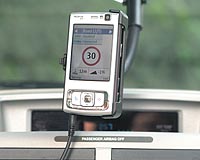
Van Buren TWP MI (SPX) Mar 12, 2009 Technology has been unveiled enabling vehicles to "see" beyond the horizon through the use of internet-enabled mobile phone communications, GPS and advanced mapping data. The Sentience research vehicle, developed by Ricardo and UK-based research partners, demonstrated that fuel savings of between 5 and 24 percent are possible at modest cost by integrating these modules with the car's hybrid control system. The technology is the result of a 15-month collaborative research effort among Ricardo, Jaguar-Land Rover, TRL, Ordnance Survey and Orange Business Services, with partial funding provided by innovITS, a UK Centre of Excellence. The project was aimed at cost-effectively reducing exhaust emissions and CO(2) output by extending the electronic horizon of the vehicle using internet-enabled mobile communications, GPS, advanced mapping and other sophisticated real-time navigational technologies. "Sentience has been a unique partnership between three industries that would not normally work together," said Tom Robinson, Sentience project director, Ricardo. "Through this collaboration, we've proven there is significant potential when onboard vehicle systems are connected with mobile communications and advanced-mapping technologies." Through an advanced form of adaptive cruise control linked to the vehicle's hybrid powertrain system, a variety of information will calculate and determine an optimal driving strategy. Its control system adjusts vehicle speed, acceleration and deceleration. Using GPS and mapping data, the system takes into account speed limits, traffic conditions, road gradient, bends and even speed bumps, as well as less predictable road features including traffic lights. Data provided by mapping and navigational systems is also used to optimize the recharging strategy of a hybrid's batteries, increasing the potential availability of electric-only mode in urban environments. Although not implemented on the project vehicle, the Enhanced Acceleration/Deceleration implementation has the necessary links to work with real-time traffic information to update its strategy according to prevailing conditions and areas of congestion. In track-based tests, the EAD strategy has demonstrated fuel savings of between 5 and 24 percent depending on traffic conditions and route topology. Share This Article With Planet Earth
Related Links Ricardo GPS Applications, Technology and Suppliers
 Avineon To Provide GIS Data Clean-Up And Realignment Services
 Alexandria VA (SPX) Mar 12, 2009
Avineon has announced NorthWestern Energy has awarded the company a GIS data clean-up and realignment services contract. Avineon will be responsible for realigning overhead and underground electric facilities as well as gas facilities and NorthWestern's specific landbase information to a state-wide cadastral landbase. |
|
|

| The content herein, unless otherwise known to be public domain, are Copyright 1995-2007 - SpaceDaily.AFP and UPI Wire Stories are copyright Agence France-Presse and United Press International. ESA Portal Reports are copyright European Space Agency. All NASA sourced material is public domain. Additional copyrights may apply in whole or part to other bona fide parties. Advertising does not imply endorsement,agreement or approval of any opinions, statements or information provided by SpaceDaily on any Web page published or hosted by SpaceDaily. Privacy Statement |
 del.icio.us
 Digg
Digg Reddit
 YahooMyWeb
 Google
 Facebook