
 |
 |
 |
 |
 |
 |
 |
 |
 |

 |
Separating The Good Bugs From The Bad Bugs
Boston MA (SPX) Apr 20, 2009 Scientists at MIT and Brown University studying how marine bacteria move recently discovered that a sharp variation in water current segregates right-handed bacteria from their left-handed brethren, impelling the microbes in opposite directions. This finding and the possibility of quickly and cheaply implementing the segregation of two-handed objects in the laboratory could have a big impact on industries like the pharmaceutical industry, for which the separation of right-handed from left-handed molecules can be crucial to a drug's safety. While single-celled bacteria do not have hands, their helical-shaped flagella spiral either clockwise or counter-clockwise, making opposite-turning flagella similar to human hands in that they create mirror images of one another that cannot be superimposed. This two-handed quality is called chirality, and in a molecule, it can make the difference between healing and harming the human body. "This discovery could impact our understanding of how water currents affect ocean microbes, particularly with respect to their ability to forage for food, since chiral effects make them drift off-course. But it is also important for several industries that rely upon the ability to separate two-handed molecules." said Roman Stocker, the Doherty Assistant Professor of Ocean Utilization in the MIT Department of Civil and Environmental Engineering, and a principal investigator of the research. One of the best-known instances of a chiral molecule causing widespread harm occurred in the 1950s, when the drug thalidomide was given to pregnant women to prevent morning sickness. One naturally occurring form-or isomer-of thalidomide reduces nausea; the other causes birth defects. In another commonly used chiral drug, naproxen, one isomer is analgesic; the other causes liver damage. Stocker and graduate student Marcos, along with co-authors Henry Fu and Professor Thomas Powers of Brown University, published their findings in the April 17 issue of Physical Review Letters. In the paper, the researchers describe how they designed a microfluidic environment-a device about the size of an iPod nano that has channels containing water and bacteria-to create a "shear" flow of adjacent layers of water moving at different speeds. In their tests, Stocker and Marcos used a non-motile mutant of the bacterium Leptospira biflexa, whose entire body has the shape of a right-handed helix. They injected the Leptospira into the center of the microfluidic device and demonstrated that they drift off-course in a direction dictated by their chirality. But the researchers did much more than observe the microbes under a microscope. In addition to the experimental data they gathered, with their Brown colleagues the MIT researchers also developed a rigorous mathematical model of the process. They are currently implementing this new approach to separate objects at molecular scales. "The methods currently used to separate chiral molecules are far more expensive and far slower than the microfluidic option. While we still have some way to go to separate actual chiral molecules, we think our work is very promising for the agriculture, food and pharmaceutical industries." said Marcos. Share This Article With Planet Earth
Related Links Massachusetts Institute of Technology, Department of Civil and Environmental Engineering Darwin Today At TerraDaily.com
 How Life Shatters The Chemistry Mirror
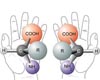 Moffett Field CA (SPX) Apr 17, 2009
All of us are left-handed. At least, the bits that make up our proteins are. This is surprising since Nature is predominantly ambidextrous when it comes to assembling these molecules from scratch. Some scientists argue that left-handedness was handed down to us from space, but others say it just happened by chance in some little nook on the primordial Earth. |
|
|

| The content herein, unless otherwise known to be public domain, are Copyright 1995-2007 - SpaceDaily.AFP and UPI Wire Stories are copyright Agence France-Presse and United Press International. ESA Portal Reports are copyright European Space Agency. All NASA sourced material is public domain. Additional copyrights may apply in whole or part to other bona fide parties. Advertising does not imply endorsement,agreement or approval of any opinions, statements or information provided by SpaceDaily on any Web page published or hosted by SpaceDaily. Privacy Statement |
 del.icio.us
 Digg
Digg Reddit
 YahooMyWeb
 Google
 Facebook