
 |
 |
 |
 |
 |
 |
 |
 |
 |

 |
September Launch For ESA's Water Mission
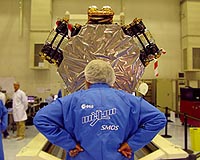
Paris, France (SPX) Apr 28, 2009 Following confirmation from Eurockot Launch Services that they will launch ESA's SMOS mission on 9 September this year, the satellite has just been taken out of storage - providing an opportunity for the media to view the satellite before it is prepared for shipment to the launch site in Russia. The Soil Moisture and Ocean Salinity (SMOS) mission is the next Earth Explorer in line for liftoff after the successful launch of the Gravity field and steady-state Ocean Circulation Explorer (GOCE) six weeks ago. After being in storage at Thales Alenia Space in the south of France for almost a year, the SMOS satellite has just been unveiled and presented to the media at a one-day event held on 24 April. Leading journalists from around Europe gathered in Cannes, France to view the SMOS satellite first hand and learn more about how this mission will employ new technology to improve our understanding of Earth's water cycle. This satellite consists of a generic platform called Proteus provided by the French space agency CNES that carries a novel instrument called the Microwave Imaging Radiometer using Aperture Synthesis (MIRAS) developed by EADS-CASA Espacio in Spain. SMOS is the first satellite mission to carry a polar-orbiting 2D interferometric radiometer. ESA's SMOS Project Manager Achim Hahne, was on hand at the event to explain how the mission works and answer questions. He commented that, "After a long idle period, we now see light at the end of the tunnel and can start to do the final planning and preparations for the launch campaign." Through the use of this new technology SMOS will measure concentrations of moisture in soil and salt in the oceans for a deeper understanding of the water cycle and a better understanding of how a changing climate may be affecting patterns of evaporation over the ocean and land. Data on salinity in the surface waters of the oceans will also advance our knowledge of ocean circulation, which is important in moderating the climate. The SMOS satellite is about to undergo some testing prior to the Flight Acceptance Review on 25 May, which is expected to signal the 'green light' for shipment to the Plesetsk Cosmodrome in northern Russia. Once it has arrived safely at the launch site in the summer, the satellite will be thoroughly tested and prepared for launch on 9 September. ESA is launching Proba-2 along with SMOS. The Proba-2 satellite serves as a test bed for 17 new technological developments and carries experiments to observe the Sun and contribute to research into space weather. Share This Article With Planet Earth
Related Links SMOS Proba Earth Observation News - Suppiliers, Technology and Application
 TerraSAR-X Image Of The Month: The Wadden Sea In North Frisia
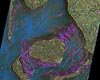 Bonn, Germany (SPX) Apr 24, 2009
The image shows the mudflats near the island of Sylt. It was compiled from two satellite images that were taken by the German radar satellite TerraSAR-X in April and May 2008. The individual pictures are coloured red and green respectively. |
|
|

| The content herein, unless otherwise known to be public domain, are Copyright 1995-2007 - SpaceDaily.AFP and UPI Wire Stories are copyright Agence France-Presse and United Press International. ESA Portal Reports are copyright European Space Agency. All NASA sourced material is public domain. Additional copyrights may apply in whole or part to other bona fide parties. Advertising does not imply endorsement,agreement or approval of any opinions, statements or information provided by SpaceDaily on any Web page published or hosted by SpaceDaily. Privacy Statement |
 del.icio.us
 Digg
Digg Reddit
 YahooMyWeb
 Google
 Facebook