
 |
 |
 |
 |
 |
 |
 |
 |
 |

 |
Shuttle Discovery lifts off, enters orbit
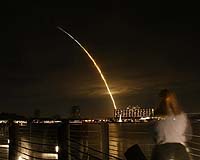
Cape Canaveral (AFP) March 15, 2009 The shuttle Discovery blasted off Sunday, on a mission to outfit the International Space Station with a final pair of solar wings ahead of the arrival in a few weeks of an expanded space crew. The spacecraft launched at 7:43 pm (2343 GMT) from the Kennedy Space Center in Florida, after being delayed last week. Within moments the shuttle was flying at seven thousand miles (11,200 kilometers) per hour, NASA said. Moments later the spacecraft entered orbit. The seven-member crew was to deliver and install the fourth and final pair of solar wings on the orbiting ISS, in one of the last major construction tasks of the more than decade-long effort to construct the station. The mission has been shortened by one day after a hydrogen leak last week led to a scrub of an earlier launch date. But NASA officials said that the problem had been cleared up and that there has been no recurrence of the malfunction. The leak was discovered Wednesday, when the external tank was 98 percent full of liquid hydrogen prompting it to be emptied for the checks. Once the Discovery mission installs the solar truss -- last major segment to be attached to the ISS -- the space station will become fully operational and capable of housing six astronauts, NASA said. The mission also will allow space officials to make a swap of personnel, exchanging Japanese astronaut Koichi Wakata for US astronaut Sandra Magnus, who will be returning to Earth after four months in space. Wakata, of the Japan Aerospace Exploration Agency, is to become the first Japanese crew member on the station. The first elements of the space station were launched in November 1998. Installing the solar panels on the 100-billion-dollar station was to take a two-astronaut team four space walks of more than six hours each to complete, according to NASA's original plans. The pairs of solar panels, containing 32,800 solar cells, are each 35 meters (115 feet) long. The final array, once in place, should boost available energy to the ISS to 120 kilowatts from the current 90. The extra power will help run the expanded array of scientific experiments to be conducted in the ISS, which saw the addition over the past year of NASA workspace and a pair of international laboratories -- Europe's Columbus and Japan's Kibo. Last week's scrubbed launch has forced space officials to shorten what had been planned as a 14-day mission to 13 days, and forced NASA to scrap one of four planned spacewalks. Officials said the scheduling adjustments should not affect the mission to deliver and install a fourth pair of solar panels to the ISS. The main purpose of the space station is to provide a zero-gravity environment for scientific experiments. However, at present, there is insufficient staff to simultaneously conduct research and maintain the space station. With additional power provided by the soon to be installed solar panels, astronauts are expected to finish preparing the space station for full operation, to about 100 kilowatts, equivalent to that used in 40 to 50 houses. The panels will supply power for onboard laboratories and for the station's crew, which will double from three to six in May. Share This Article With Planet Earth
Related Links Shuttle at NASA Watch NASA TV via Space.TV Space Shuttle News at Space-Travel.Com
 Shuttle Repairs Work Proceeds - Weather Forecast Is Good
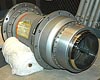 Cape Camnaveral FL (SPX) Mar 14, 2009
Repairs are under way on the Ground Umbilical Carrier Plate (GUCP) interface, where gaseous hydrogen leaked during Wednesday's launch attempt. The interface then will be retested and leak checked before Sunday's 7:43 p.m. launch attempt. |
|
|

| The content herein, unless otherwise known to be public domain, are Copyright 1995-2007 - SpaceDaily.AFP and UPI Wire Stories are copyright Agence France-Presse and United Press International. ESA Portal Reports are copyright European Space Agency. All NASA sourced material is public domain. Additional copyrights may apply in whole or part to other bona fide parties. Advertising does not imply endorsement,agreement or approval of any opinions, statements or information provided by SpaceDaily on any Web page published or hosted by SpaceDaily. Privacy Statement |
 del.icio.us
 Digg
Digg Reddit
 YahooMyWeb
 Google
 Facebook