
 |
 |
 |
 |
 |
 |
 |
 |
 |

 |

Huntsville AL (SPX) Oct 26, 2010 In the hostile environment of space, satellites could get burned by the ultra-hot sun in front of them and chilled by the frigid cold conditions of space behind them. Researchers at NASA's Marshall Space Flight Center in Huntsville, Ala., are using their Solar Thermal Test Facility to simulate some of the harshest conditions space has to offer to learn what these extreme temperatures can do to flight hardware close to the sun. They're currently testing Strofio, a unique NASA instrument that will fly aboard an upcoming European Space Agency mission, in this facility to test the thermal balance before the instrument is on its way to Mercury. The facility looks like it belongs in a galaxy far, far away. A two-story tall curved mirror - actually is made of 144 separate mirror segments, each hexagonally shaped and about 18 inches in diameter - forms the backbone of the facility. About 50 yards away, sitting in a field, lies another mirror tilted at a slight angle. This secondary mirror reflects the sun towards the primary mirror, which captures the energy and then focuses inside a small vacuum chamber mounted in front of the mirror's focal point. The giant wall of mirrors works by capturing the light from the sun and redirecting that energy to whatever happens to be sitting in the vacuum chamber. That superheats the instrument, allowing scientists to know how their hardware will behave as it nears the sun. Of course they can't use all 144 mirror segments at once - that would beam 5000 watts worth of energy onto whatever happens to be inside the vacuum chamber. For the Strofio tests, engineers will only need to partially uncover about 26 mirror segments. They'll reach temperatures hot enough to test their instrument, but not so high that they melt away their hard work. But that's only half the equation. Thanks to the Southwest Research Institute, the NASA facility has installed a liquid nitrogen shroud on the inside of the vacuum chamber that will flow super-cold liquid nitrogen. That will allow engineers to chill the vacuum chamber to the freezing cold temperatures, just like those in deep space. In the front, the mirrors expose the instrument to the hotness of the sun. In the back, the nitrogen exposes it to the coldness of a vacuum. Together they accurately mimic the conditions of space, allowing scientists to test how their instrument will perform on its actual mission. "It really gives you a good opportunity to understand how your instrument will perform in the conditions of deep space," says Dr. Jimmy Lee, mission manager for Strofio. "We're trying to understand on Earth how our tool will perform thousands of miles away in radically different conditions. That's critical for a mission like ours." These tests prove vital for equipment like Stofio that are destined to travel close to the sun. Strofio will fly in polar orbit around Mercury where it will determine the chemical composition of Mercury's surface using a technique called mass spectroscopy, providing a powerful new data to study the planet's geological history. It will launch with the ESA's Mercury Planetary Orbiter mission in 2014. When Strofio reaches its orbit around mercury, the sun will expose it to temperatures over 120 degrees Celsius or 248 Fahrenheit. That's a stretch even for the relatively resilient NASA computers which historically only operate at around 24 degrees Celsius or 75 Fahrenheit. Engineers will have to continuously test Strofio to handle the tough Mercury conditions. For now, the Solar Thermal Test Facility's team continues to test Strofio in preparation for its upcoming mission. Hopefully, they'll continue to have the opportunity to bring the conditions of deep space to the middle of Huntsville, Ala.
Share This Article With Planet Earth
Related Links NASA Space Tourism, Space Transport and Space Exploration News

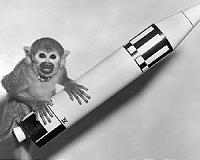 ADI Advances US Legislative Campaign Against Planned NASA Primate Experiments
Los Angeles CA (SPX) Sep 27, 2010 Animal Defenders International (ADI), the leading animal welfare organization that works globally for the protection of animals, launched a major U.S. educational and legislative campaign to secure public and government support to prevent NASA from proceeding with irradiating squirrel monkeys to study adverse effects of space radiation. The centerpiece of the legislative campaign is a comp ... read more |
|
|
| The content herein, unless otherwise known to be public domain, are Copyright 1995-2010 - SpaceDaily. AFP and UPI Wire Stories are copyright Agence France-Presse and United Press International. ESA Portal Reports are copyright European Space Agency. All NASA sourced material is public domain. Additional copyrights may apply in whole or part to other bona fide parties. Advertising does not imply endorsement,agreement or approval of any opinions, statements or information provided by SpaceDaily on any Web page published or hosted by SpaceDaily. Privacy Statement |


 del.icio.us
 Digg
Digg Reddit
 YahooMyWeb
 Google
 Facebook


