
 |
 |
 |
 |
 |
 |
 |
 |
 |

 |
Sizing Up Asteroids
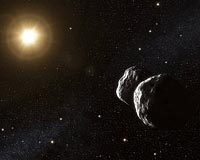
Moffett Field CA (SPX) Feb 11, 2009 A team of French and Italian astronomers have devised a new method for measuring the size and shape of asteroids that are too small or too far away for traditional techniques, increasing the number of asteroids that can be measured by a factor of several hundred. This method takes advantage of the unique capabilities of ESO's Very Large Telescope Interferometer (VLTI). "Knowledge of the sizes and shapes of asteroids is crucial to understanding how, in the early days of our solar system, dust and pebbles collected together to form larger bodies and how collisions and re-accumulation have since modified them," says Marco Delbo from the Observatoire de la C�te d'Azur, France, who led the study. Understanding this early evolution of solar system bodies can help astrobiologists understand how to identify distant systems capable of supporting rocky planets. Direct imaging with adaptive optics on the largest ground-based telescopes such as the Very Large Telescope (VLT) in Chile and space telescopes, or radar measurements are the currently favored methods of asteroid measurement. However, direct imaging, even with adaptive optics, is generally limited to the one hundred largest asteroids of the main belt, while radar measurements are mostly constrained to observations of near-Earth asteroids that experience close encounters with our planet. Delbo and his colleagues have devised a new method that uses interferometry to resolve asteroids as small as about 15 km in diameter located in the main asteroid belt, 200 million kilometres away. This is equivalent to being able to measure the size of a tennis ball a distance of a thousand kilometres. This technique will not only increase the number of objects that can be measured dramatically, but, more importantly, bring small asteroids that are physically very different from the well studied larger ones into reach. The interferometric technique combines the light from two or more telescopes. Astronomers proved their method using ESO's VLTI, combining the light of two of the VLT's 8.2-metre Unit Telescopes. "This is equivalent to having vision as sharp as that of a telescope with a diameter equal to the separation between the two VLT Unit Telescopes used, in this case, 47 metres," says co-author Sebastiano Ligori, from INAF-Torino, Italy. The researchers applied their technique to the main belt asteroid (234) Barbara, which was earlier found, by co-author Alberto Cellino, to have rather unusual properties. Although it is so far away, the VLTI observations also revealed that this object has a peculiar shape. The best fit model is composed of two bodies each the size of a major city - with diameters of 37 and 21 km - separated by at least 24 km. "The two parts appear to overlap," says Delbo, "so the object could be shaped like a gigantic peanut or, it could be two separate bodies orbiting each other." If Barbara proves to be a double asteroid, this is even more significant: by combining the diameter measurements with the parameters of the orbits, astronomers can then compute the density of these objects. "Barbara is clearly a high priority target for further observations," concludes Ligori. Having proven the validity of their new and powerful technique, the team can now start a large observing campaign to study small asteroids. Share This Article With Planet Earth
Related Links ESO Asteroid and Comet Mission News, Science and Technology
 Current Status Of The Asteroid Explorer Hayabusa
 Tokyo, Japan (SPX) Feb 06, 2009
The Japan Aerospace Exploration Agency is doing its best to operate the Asteroid Explore "HAYAUBSA" to return it to Earth in June 2010. |
|
|

| The content herein, unless otherwise known to be public domain, are Copyright 1995-2007 - SpaceDaily.AFP and UPI Wire Stories are copyright Agence France-Presse and United Press International. ESA Portal Reports are copyright European Space Agency. All NASA sourced material is public domain. Additional copyrights may apply in whole or part to other bona fide parties. Advertising does not imply endorsement,agreement or approval of any opinions, statements or information provided by SpaceDaily on any Web page published or hosted by SpaceDaily. Privacy Statement |
 del.icio.us
 Digg
Digg Reddit
 YahooMyWeb
 Google
 Facebook