
 |
 |
 |
 |
 |
 |
 |
 |
 |

 |
Small Galaxies Shape Large Galaxies
Pittsburgh PA (SPX) Nov 24, 2008 The bright pinwheels and broad star sweeps iconic of disk galaxies such as the Milky Way might all be the shrapnel from massive, violent collisions with other galaxies and galaxy-size chunks of dark matter, according to a multi-institutional project involving the University of Pittsburgh. Published in "The Astrophysical Journal," the findings challenge the longstanding theory that the bright extensions and rings surrounding galaxies are the remnants of smaller star clusters that struck a larger, primary galaxy then fragmented. The study's team consisted of Andrew Zentner, a professor of physics and astronomy in Pitt's School of Arts and Sciences; James Bullock, a physics and astronomy professor at the University of California at Irvine; Stelios Kazantzidis, a postdoctoral researcher at Ohio State University; Andrey Kravtsov, a professor of astronomy and astrophysics at the University of Chicago; and Leonidas Moustakas, a researcher at the NASA Jet Propulsion Laboratory, California Institute of Technology. The team's computer simulations of galaxy formation suggests that disk galaxies most likely began as flat, centralized star clusters. Smaller galaxies collided with and tore through these disks billions of years ago, casting disk stars outward into the wild extensions present now; the bright center is the original formation. In addition, vast bodies of dark matter-a low-density, high-gravity invisible mass thought to occupy nearly one-quarter of the Universe-swept through these disks and further pulled stars from the main disk. The researchers' scenario largely applies to the formation of the rings and long flares of stars that surround such galaxies as the Milky Way, Zentner said. But the model also presents a possible solution to how star spirals-the arcs of stars that radiate from the center of some disk galaxies-maintain their shape. Spirals form as a result of any disturbance to the star disk, Zentner said. However, the prolonged disturbance of a galaxy and dark matter expanse passing through a disk explains why the spirals seem to never recede. "Our model suggests that a violent collision throws stars everywhere and continues moving through the disk, disturbing its structure," Zentner said. "It also has been known for some time that for star spirals to develop and maintain their well-known form, there must be a prolonged disturbance. We show that large masses moving through a galaxy could provide that disturbance." The team's findings were serendipitous, Zentner explained. They were modeling disk galaxies for an unrelated astrological survey when they inadvertently discovered that stars in the main disk scattered when satellite galaxies-smaller galaxies surrounding larger ones-passed through. They shared their results with colleagues a year ago, and the results have since been replicated, Zentner said. "One of the major advantages of these results is that we didn't set out to find them," he said. "They happened as we simulated existing galaxies." Share This Article With Planet Earth
Related Links University of Pittsburgh Stellar Chemistry, The Universe And All Within It
 Hubble Resolves Puzzle About Loner Starburst Galaxy
 Baltimore MD (SPX) Nov 21, 2008
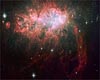
Astronomers have long puzzled over why a small, nearby, isolated galaxy is pumping out new stars faster than any galaxy in our local neighborhood. |
|
|

| The content herein, unless otherwise known to be public domain, are Copyright 1995-2007 - SpaceDaily.AFP and UPI Wire Stories are copyright Agence France-Presse and United Press International. ESA Portal Reports are copyright European Space Agency. All NASA sourced material is public domain. Additional copyrights may apply in whole or part to other bona fide parties. Advertising does not imply endorsement,agreement or approval of any opinions, statements or information provided by SpaceDaily on any Web page published or hosted by SpaceDaily. Privacy Statement |

 del.icio.us
 Digg
Digg Reddit
 YahooMyWeb
 Google
 Facebook