
 |
 |
 |
 |
 |
 |
 |
 |
 |

 |

Cambridge MA (SPX) Jan 05, 2011 During a total eclipse of the Sun, skywatchers are awed by the shimmering corona - a faint glow that surrounds the Sun like gossamer flower petals. This outer layer of the Sun's atmosphere is, paradoxically, hotter than the Sun's surface, but so tenuous that its light is overwhelmed by the much brighter solar disk. The corona becomes visible only when the Sun is blocked, which happens for just a few minutes during an eclipse. Now, an instrument on board NASA's Solar Dynamics Observatory (SDO), developed by Smithsonian scientists, is giving unprecedented views of the innermost corona 24 hours a day, 7 days a week. "We can follow the corona all the way down to the Sun's surface," said Leon Golub of the Harvard-Smithsonian Center for Astrophysics (CfA). Previously, solar astronomers could observe the corona by physically blocking the solar disk with a coronagraph, much like holding your hand in front of your face while driving into the setting Sun. However, a coronagraph also blocks the area immediately surrounding the Sun, leaving only the outer corona visible. The Atmospheric Imaging Assembly (AIA) instrument on SDO can "fill" this gap, allowing astronomers to study the corona all the way down to the Sun's surface. The resulting images highlight the ever-changing connections between gas captured by the Sun's magnetic field and gas escaping into interplanetary space. The Sun's magnetic field molds and shapes the corona. Hot solar plasma streams outward in vast loops larger than Earth before plunging back onto the Sun's surface. Some of the loops expand and stretch bigger and bigger until they break, belching plasma outward. "The AIA solar images, with better-than-HD quality views, show magnetic structures and dynamics that we've never seen before on the Sun," said CfA astronomer Steven Cranmer. "This is a whole new area of study that's just beginning." Cranmer and CfA colleague Alec Engell developed a computer program for processing the AIA images above the Sun's edge. These processed images imitate the blocking-out of the Sun that occurs during a total solar eclipse, revealing the highly dynamic nature of the inner corona. They will be used to study the initial eruption phase of coronal mass ejections (CMEs) as they leave the Sun and to test theories of solar wind acceleration based on magnetic reconnection.
Share This Article With Planet Earth
Related Links Harvard-Smithsonian Center for Astrophysics Solar Science News at SpaceDaily

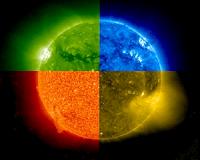 Seeing Through The Layers Of The Sun
Greenbelt MD (SPX) Jan 05, 2011 One can virtually peer through layers of the Sun to see different kinds of features using images taken at almost the same time (Dec. 19, 2010). Each STEREO spacecraft images the Sun in four wavelengths of extreme UV light. People cannot see UV light, but carefully designed instruments can. Frames from each wavelength are colorized so that scientists know instantly which wavelength th ... read more |
|
|
| The content herein, unless otherwise known to be public domain, are Copyright 1995-2010 - SpaceDaily. AFP and UPI Wire Stories are copyright Agence France-Presse and United Press International. ESA Portal Reports are copyright European Space Agency. All NASA sourced material is public domain. Additional copyrights may apply in whole or part to other bona fide parties. Advertising does not imply endorsement,agreement or approval of any opinions, statements or information provided by SpaceDaily on any Web page published or hosted by SpaceDaily. Privacy Statement |


 del.icio.us
 Digg
Digg Reddit
 YahooMyWeb
 Google
 Facebook


