
 |
 |
 |
 |
 |
 |
 |
 |
 |

 |
Solar-Powered Sea Slugs Live Like Plants
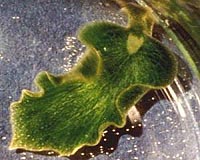
College Station TX (SPX) Nov 27, 2008 The lowly sea slug, "Elysia chlorotica," may not seem like the most exciting of creatures, but don't be fooled: it behaves like a plant and is solar-powered, says a Texas A and M University biologist who has been studying these tiny creatures for the past decade and, along with collaborators from several universities, has identified a possible cause of their ability to behave like plants. Biology professor James Manhart is a member of a research group that believes they have identified some of the secrets of the sea slug and its curious plant-like behavior. These research findings have been published in the current issue of "Proceedings of National Academy of Sciences" with an image of a green slug gracing the cover. Manhart says plants can be compared to solar-powered machines-their cells contain tiny organelles called plastids that trap sunlight and convert it into energy by a process known as photosynthesis. Animals, on the other hand, depend on plants or other animals for their energy needs. The sea slug, however, works a little differently. Its main food source is a specific type of alga. "It makes a cut in the alga, sucks out the cytoplasm [the material inside the alga] and digests most of it," explains Manhart. But there's a twist - it retains the plastids that trap the solar energy. These plastids remain in the slug, continue to photosynthesize and provide food for the slug. In effect, the creature becomes a solar-powered slug and is able to make its own food like plants do. "Photosynthesis needs around 2,000 to 3,000 genes, and animals do not have many of the critical genes," says Manhart. So Manhart and his co-workers looked into how the plastids consumed by the slug can continue photosynthesizing. "We found that the slug has at least one gene required for photosynthesis in its nuclear genome, which has never been found in any animal," says Manhart. "The critical thing is the plastids come from the alga, but the slug nucleus contains at least one, and probably more of the genes required for plastid functioning," he adds. "The slug needs the alga to mature and complete its life cycle," Manhart says. "It is totally dependent on the alga to survive. Once the slug has acquired a sufficient amount of plastids it can survive, like plants, for at least nine months by trapping solar energy and converting it into food." That means the "baby" slugs are born with genes that support photosynthesis, but they have to gather their own plastids. Manhart says that if the slug and the alga both brave the ever-changing climatic conditions, the slug might evolve into a truly photosynthetic animal-that is, one born with the plastids. But that might be looking too far into the future. For now, he says, the next step would be sequencing the slug's genome. Share This Article With Planet Earth
Related Links Texas A and M University Darwin Today At TerraDaily.com
 Climate Change Wiped Out Cave Bears 13 Millennia Earlier Than Thought
 Vienna, Austria (SPX) Nov 27, 2008
Enormous cave bears, Ursus spelaeus, that once inhabited a large swathe of Europe, from Spain to the Urals, died out 27,800 years ago, around 13 millennia earlier than was previously believed, scientists have reported. |
|
|

| The content herein, unless otherwise known to be public domain, are Copyright 1995-2007 - SpaceDaily.AFP and UPI Wire Stories are copyright Agence France-Presse and United Press International. ESA Portal Reports are copyright European Space Agency. All NASA sourced material is public domain. Additional copyrights may apply in whole or part to other bona fide parties. Advertising does not imply endorsement,agreement or approval of any opinions, statements or information provided by SpaceDaily on any Web page published or hosted by SpaceDaily. Privacy Statement |
 del.icio.us
 Digg
Digg Reddit
 YahooMyWeb
 Google
 Facebook