
 |
 |
 |
 |
 |
 |
 |
 |
 |

 |
Solar Wind Tans Young Asteroids
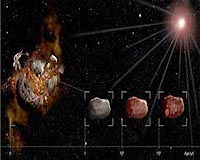
Paris, France (SPX) Apr 24, 2009 A new study published in Nature reveals that asteroid surfaces age and redden much faster than previously thought - in less than a million years, the blink of an eye for an asteroid. This study has finally confirmed that the solar wind is the most likely cause of very rapid space weathering in asteroids. This fundamental result will help astronomers relate the appearance of an asteroid to its actual history and identify any after effects of a catastrophic impact with another asteroid. "Asteroids seem to get a 'sun tan' very quickly," says lead author Pierre Vernazza. "But not, as for people, from an overdose of the Sun's ultraviolet radiation, but from the effects of its powerful wind." It has long been known that asteroid surfaces alter in appearance with time - the observed asteroids are much redder than the interior of meteorites found on Earth - but the actual processes of this "space weathering" and the timescales involved were controversial. Thanks to observations of different families of asteroids using ESO's New Technology Telescope at La Silla and the Very Large Telescope at Paranal, as well as telescopes in Spain and Hawaii, Vernazza's team have now solved the puzzle. When two asteroids collide, they create a family of fragments with "fresh" surfaces. The astronomers found that these newly exposed surfaces are quickly altered and change colour in less than a million years - a very short time compared to the age of the Solar System. "The charged, fast moving particles in the solar wind damage the asteroid's surface at an amazing rate [3]", says Vernazza. Unlike human skin, which is damaged and aged by repeated overexposure to sunlight, it is, perhaps rather surprisingly, the first moments of exposure (on the timescale considered) - the first million years - that causes most of the aging in asteroids. By studying different families of asteroids, the team has also shown that an asteroid's surface composition is an important factor in how red its surface can become. After the first million years, the surface "tans" much more slowly. At that stage, the colour depends more on composition than on age. Moreover, the observations reveal that collisions cannot be the main mechanism behind the high proportion of "fresh" surfaces seen among near-Earth asteroids. Instead, these "fresh-looking" surfaces may be the results of planetary encounters, where the tug of a planet has "shaken" the asteroid, exposing unaltered material. Thanks to these results, astronomers will now be able to understand better how the surface of an asteroid - which often is the only thing we can observe - reflects its history. Share This Article With Planet Earth
Related Links ESO Asteroid and Comet Mission News, Science and Technology
 Next Stop Asteroid Ceres
 Moffett Field CA (SPX) Apr 17, 2009
With solar system exploration progressing at pace, some scientists are considering missions to often overlooked worlds. One of these is Ceres, the smallest known dwarf planet which lies within the asteroid belt. Investigations have shown that it is an excellent target for exploration and may even have astrobiological significance. |
|
|

| The content herein, unless otherwise known to be public domain, are Copyright 1995-2007 - SpaceDaily.AFP and UPI Wire Stories are copyright Agence France-Presse and United Press International. ESA Portal Reports are copyright European Space Agency. All NASA sourced material is public domain. Additional copyrights may apply in whole or part to other bona fide parties. Advertising does not imply endorsement,agreement or approval of any opinions, statements or information provided by SpaceDaily on any Web page published or hosted by SpaceDaily. Privacy Statement |
 del.icio.us
 Digg
Digg Reddit
 YahooMyWeb
 Google
 Facebook