
 |
 |
 |
 |
 |
 |
 |
 |
 |

 |
Some 100 countries sign ban on cluster bombs
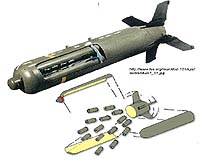
Oslo (AFP) Dec 3, 2008 Some 100 nations put their names Wednesday to a landmark treaty banning cluster bombs, amid calls for major arms producers such as China, Russia and the United States to join them. Norway -- which played a key role in hammering out the worldwide ban on using, producing, transferring and stockpiling cluster munitions -- was the first of 92 countries to sign the Convention on Cluster Munitions (CCM) on Wednesday, with another handful expected on Thursday. "This is a historic day when a majority of states are committing to ban cluster munitions, making a new international norm that will make a considerable difference for thousands and thousands of people all over the world," Norwegian Foreign Minister Jonas Gahr Stoere said after signing the treaty. Dropped from warplanes or fired from artillery guns, cluster bombs explode in mid-air to randomly scatter hundreds of bomblets, which can be just eight centimetres (three inches) big. Many bomblets fail to explode, littering war zones with de facto landmines that can kill and maim long after a conflict ends. Worldwide, about 100,000 people have been killed or maimed by cluster bombs since 1965, 98 percent of them civilians, according to campaign group Handicap International. More than a quarter of the victims are children who mistake the bomblets for toys or tin cans. Laos, the country most affected by cluster bombs, was the second nation to sign Wednesday's treaty at Oslo city hall. Between 1964 and 1973, the US Air Force dropped 260 million cluster bombs on Laos, or the equivalent of a fully-loaded B-52 bomber's payload dropped every eight minutes for nine years. "The world is a safer place today," Richard Moyes of the Cluster Munitions Coalition, an umbrella group that comprises some 300 non-governmental organisations, told AFP as the signing of Wednesday's treaty began. "This is the biggest humanitarian treaty of the last decade." Over two days, around 100 countries -- including Britain, Canada, France and Germany -- are to sign the treaty that was finalised in Dublin in May, with the final number of signatory states only to be known at the end of the ceremony on Thursday. "We hope to see more states signing in the coming weeks, the coming months, the coming years," Stoere said, lamenting that the world's biggest producers and users of cluster bombs have refused to sign the ban. "Of course, (the treaty) would have been a stronger instrument if we had the US, Russia, China, Israel, Pakistan and India onboard. No doubt about it," he said. "We have to put friendly pressure on them to sign," French Foreign Minister Bernard Kouchner told reporters, adding "I have no doubt they will do it someday." British Foreign Secretary David Miliband said the United States and president-elect Barack Obama needed some prodding. "We have to argue with the new administration that this is a good thing for everybody," he said. But Washington reiterated its opposition Tuesday. "Although we share the humanitarian concerns of states signing the CCM, we will not be joining them," the US State Department said in a statement. "Such a general ban on cluster munitions will put the lives of our military men and women, and those of our coalition partners, at risk." Despite the absence of key countries, opponents of cluster bombs say the treaty -- also known as the Oslo Convention -- should help stigmatise the use of such weapons even by non-signatory countries. "The treaty places moral obligations on all states not to use cluster munitions," Norwegian Prime Minister Jens Stoltenberg said. In a surprise turnaround, Afghanistan said Wednesday it would sign the Oslo Convention after it had been seen as bowing to US pressure to refrain. Activists welcomed Kabul's last-minute change of heart, noting that Afghanistan was the target of tens of thousands of cluster bombs dropped by the United States in 2001 and 2002. Before it can go into effect, the Oslo treaty must be ratified by the parliaments of at least 30 countries, something Stoere said he hoped would happen "early next year." Norway and a handful of other states have already launched the ratification process, organisers said, while a number of countries like Britain, France and Germany had begun destroying their stockpiles of the munitions. The Vatican said by ratifying the treaty on the same day it was being signed, the Holy See wanted "to give a strong political signal." Share This Article With Planet Earth
Related Links The latest in Military Technology for the 21st century at SpaceWar.com
 Hospital On A Chip Could Revolutionize Treatment Of Battlefield Wounds
 Potsdam NY (SPX) Dec 03, 2008
The battlefield of the future may react differently to combat injuries, providing instant treatment to wounded soldiers even before a medic reaches their side. |
|
|

| The content herein, unless otherwise known to be public domain, are Copyright 1995-2007 - SpaceDaily.AFP and UPI Wire Stories are copyright Agence France-Presse and United Press International. ESA Portal Reports are copyright European Space Agency. All NASA sourced material is public domain. Additional copyrights may apply in whole or part to other bona fide parties. Advertising does not imply endorsement,agreement or approval of any opinions, statements or information provided by SpaceDaily on any Web page published or hosted by SpaceDaily. Privacy Statement |
 del.icio.us
 Digg
Digg Reddit
 YahooMyWeb
 Google
 Facebook