
 |
 |
 |
 |
 |
 |
 |
 |
 |

 |
Space Station Construction Visible In Backyard Telescopes
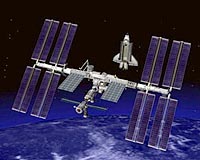
Science@NASA Huntsville AL (SPX) Mar 20, 2009 Talk about a big construction project... Astronauts are about to add a pair of 115-foot-long solar wings to the International Space Station. The station's solar arrays are the largest deployable space assemblies ever built and the most powerful electricity producing arrays in orbit. Each wing weighs 2,400 pounds, uses 32,800 individual solar cells, and adds about 4000 sq. feet of light-collecting surface area to the ISS. When the work is done, the space station will have enough usable electricity to light up 42 houses. Amateur astronomers can see it happen with their own eyes. The International Space Station is so large, its outlines are visible in backyard telescopes. "In December, the space station made a nice pass over my backyard observatory," says photographer Ralf Vandebergh of the Netherlands. "It was about as bright as Venus-you couldn't miss it." He hand-guided his telescope to keep the ISS centered in the field of view and captured the image using a digital video camera attached to the eyepiece. Vandebergh's snapshot shows six previously-installed solar wings--four port and two starboard. The new arrays will go on the starboard side, rounding out the eight-wing set. Once complete, the station's power system will generate between 80 and 120 kilowatts of usable electric power. Some of that electricity is needed to operate basic space station systems, but once that is figured in, the addition of the new arrays will nearly double the amount of power available to perform scientific experiments--from 15 kilowatts to 30 kilowatts. The extra power will also double the number of full-time crew the station can support from three to six. The new wings are en route to the ISS onboard space shuttle Discovery, which left Earth on Sunday, March 15, in a beautiful twilight launch from Kennedy Space Center. In addition to the solar arrays, Discovery is also bringing a 31,000-lb truss segment to complete the station's massive backbone and a thermal radiator to shed heat from newly-powered electronics. If all goes according to plan, the arrays, truss segment, and radiator will be installed during a spacewalk on mission Day 5 (March 19); the arrays will be unfurled accordian-style on mission Day 8 (March 22). The timing of these events favors sky watchers in the USA and Canada. The ISS (with Discovery docked) is due to fly over many North America towns and cities after sunset in mid- to late-March. Shining brighter than any star, the ISS-Discovery combo takes a leisurely 5 minutes to glide across the sky--plenty of time to point a telescope, take a picture, or just soak up some of the station's growing luminosity. Share This Article With Planet Earth
Related Links NASA's ISS tracker Science@NASA Station at NASA Station and More at Roscosmos S.P. Korolev RSC Energia Watch NASA TV via Space.TV Space Station News at Space-Travel.Com
 Expedition 18 Ready To Take A Walk
 Houston TX (SPX) Mar 10, 2009
Aboard the orbiting International Space Station Monday, the Expedition 18 crew had a bit of down time. After Sunday's suited fit check of their Orlan spacesuits, Commander Mike Fincke and Flight Engineer Yury Lonchakov relaxed Monday in advance of their spacewalk slated to begin at 12:20 p.m. EDT Tuesday. Lonchakov, the lead spacewalker or EV 1, will wear the Orlan suit with the blue stripes. |
|
|

| The content herein, unless otherwise known to be public domain, are Copyright 1995-2007 - SpaceDaily.AFP and UPI Wire Stories are copyright Agence France-Presse and United Press International. ESA Portal Reports are copyright European Space Agency. All NASA sourced material is public domain. Additional copyrights may apply in whole or part to other bona fide parties. Advertising does not imply endorsement,agreement or approval of any opinions, statements or information provided by SpaceDaily on any Web page published or hosted by SpaceDaily. Privacy Statement |
 del.icio.us
 Digg
Digg Reddit
 YahooMyWeb
 Google
 Facebook