
 |
 |
 |
 |
 |
 |
 |
 |
 |

 |

Ames IA (SPX) Aug 31, 2010 The Spitzer Space Telescope is now taking aim at the outer reaches of the Milky Way and helping two Iowa State University astronomers advance their star studies. Massimo Marengo, an assistant professor of physics and astronomy, is using data from Spitzer's infrared telescope to study big, cool-temperature stars and the dusty disks that forms around these and other stars as their planetary systems evolve. He is a co-author of a new paper that describes how tight double-star systems could be efficient "destroyers of worlds" because planet collisions may be common within the systems. The paper was published in the Aug. 19 issue of The Astrophysical Journal Letters. Charles Kerton, as associate professor of physics and astronomy, is using Spitzer data to study star-forming regions of our Milky Way galaxy. He is co-author of a new paper that uses Spitzer images to identify regions within the inner Milky Way that are forming intermediate-mass stars. The paper was published in the August issue of The Astronomical Journal. NASA's Spitzer Space Telescope launched Aug. 25, 2003, into an orbit of the sun. Its 33.5-inch diameter telescope and three scientific instruments are designed to detect infrared or heat radiation. To do that, the telescope assembly had to be cooled to within a few degrees of absolute zero (or -459 degrees Fahrenheit). The telescope ran out of liquid helium coolant last summer but is still able to collect data with its two shortest-wavelength detectors. One of the telescope's initial tasks was to survey the Milky Way's dusty, star-filled center. The telescope, as part of an astronomy survey called GLIMPSE360, is now pointed toward outer regions of the galaxy and is beginning to send images of those remote areas. The survey is led by Barbara Whitney, a senior scientist at the University of Wisconsin-Madison and a senior research scientist at the Space Science Institute in Boulder, Colo. Iowa State's Kerton and Marengo say the space telescope is an important part of their science. "It lets me see objects that are obscured," said Kerton, who helped plan the GLIMPSE360 survey. "It allows me to detect young, newly formed stars that wouldn't be seen any other way. And it shows them at a resolution that helps us understand what we're seeing." Where old surveys showed a single blob, Kerton said, the Spitzer images show a cluster of stars. Marengo started working with the Spitzer experiment before it launched. When he was on the staff of the Harvard-Smithsonian Center for Astrophysics in Cambridge, Mass., he was part of the instrument group that built and calibrated Spitzer's hardware. "Spitzer is really, really sensitive," Marengo said. "The first time it was turned on - before it was even calibrated - a 10-second exposure provided the equivalent depth of an exposure that used to take 10 hours with the 10-meter Keck telescope, the largest on Earth." That, he said, is a big advantage when astronomers are trying to observe very cool, faint stars. And for his work, he said there are no ground telescopes that can match Spitzer's capabilities. And now that the Spitzer Space Telescope is pointed away from the better-known inner galaxy, Kerton and Marengo said it will help astronomers understand unexplored parts of our galaxy through the end of the GLIMPSE360 survey early next year. "Spitzer is getting farther and farther away," Marengo said. "And it's revealing more year by year."
Share This Article With Planet Earth
Related Links Iowa State University Space Telescope News and Technology at Skynightly.com

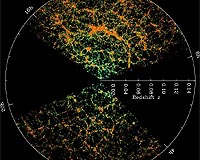 Online Universe Wins AAAS Website Award
Baltimore MD (SPX) Aug 31, 2010 A website that brings the universe into the homes and onto the computer screens of professional and amateur astronomers alike has won a Science Prize for Online Resources in Education, known as SPORE, from the American Association for the Advancement of Science. Built by a Johns Hopkins University team led by astrophysicist and computer scientist Alexander Szalay, the SkyServer search tool ... read more |
|
|
| The content herein, unless otherwise known to be public domain, are Copyright 1995-2010 - SpaceDaily. AFP and UPI Wire Stories are copyright Agence France-Presse and United Press International. ESA Portal Reports are copyright European Space Agency. All NASA sourced material is public domain. Additional copyrights may apply in whole or part to other bona fide parties. Advertising does not imply endorsement,agreement or approval of any opinions, statements or information provided by SpaceDaily on any Web page published or hosted by SpaceDaily. Privacy Statement |


 del.icio.us
 Digg
Digg Reddit
 YahooMyWeb
 Google
 Facebook


