
 |
 |
 |
 |
 |
 |
 |
 |
 |

 |
Space junk sparks crew scare on ISS
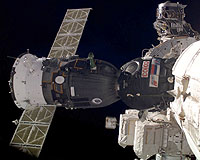
Washington (AFP) March 12, 2009 The crew of the International Space Station sought refuge in a Soyuz space capsule Thursday amid a threatened close encounter with a debris cloud, highlighting the growing dangers of space junk. The scare arose when the three member crew learned too late to take evasive action of an approaching a cloud of debris that exposed the space station to the risk of a potentially catastrophic collision. NASA appeared most concerned about a piece of a satellite motor that was close enough to ordinarily have forced the space station to undertake an evasive maneuver. But Laura Rochon, a NASA spokeswoman at the Kennedy Space Center in Florida, had said the risk of collision was "very low." "The piece itself is about one third of an inch and it's about 4.5 kilometers away," she said. Americans Mike Fincke, the mission commander, and Sandy Magnus, the number two flight engineer as well as their Russian colleague Yuri Lonchakov, the number one flight engineer, exited the space craft and battened themselves in the Soyuz spacecraft. NASA said the move was a precaution in case the crew needed to detach from the space station, NASA said. Crew members had half-locked the Soyuz doors and would have been ready to slam the hatches shut "and quickly depart the station in the unlikely event the debris had collided with the station and caused a depressurization," NASA said. The all-clear was sounded at 12:45 pm EDT (1645 GMT) about 10 minutes after the crew entered the capsule, the space agency said. "The debris threat to the International Space Station has passed," NASA said in a statement. The US Strategic Command notified NASA of the debris field late Wednesday, but NASA said it was too late for flight controllers to coordinate a "debris avoidance" maneuver. "Every once in a while, the crew has to do orbital debris avoidance maneuvers but this time they didn't do that because we have an upcoming launch possibly on Sunday and they need to stay at the same altitude," Rochon said. The US Joint Space Operations Center tracks about 18,000 objects in orbit, so many that it has to decide which to follow most closely, like those that might fly by the International Space Station or manned space flights. Experts estimate that there are more than 300,000 orbital objects measuring between one and 10 centimeters (0.4 and four inches) in diameter and "billions" of smaller pieces. Traveling at speeds of up to thousands of miles an hour they pose a risk of catastrophic damage to spacecraft. Last month, a spent Russian satellite collided with an Iridium communications satellite, showering more debris in an orbit 436 kilometers (270 miles) above the space station. US military trackers failed to anticipate that collision, the first between two intact satellites, the Pentagon said at the time. The worst debris clouds are in low Earth orbit (LEO), between 800 and 1,500 kilometers (500 and 950 miles) above the Earth, and in geostationary orbit, about 35,000 kilometers (22,000 miles) up. In January 2007, China tested an anti-satellite weapon, destroying a disused Chinese weather satellite, the Fengyun-1C, creating the largest man-made debris field in history and put 2,378 fragments greater than five centimeters (two inches) in low Earth orbit. In June 1983, the windscreen of the US space shuttle Challenger had to be replaced after it was chipped by a fleck of paint measuring 0.01 of an inch (0.3 millimeters) that impacted at 2.5 miles (four kilometers) per second. Some 6,000 satellites have been sent into space since the Soviet Union launched the first man-made orbiter, Sputnik 1, in 1957. About 800 satellites remain in operation, according to STRATCOM. Share This Article With Planet Earth
Related Links Station at NASA Station and More at Roscosmos S.P. Korolev RSC Energia Watch NASA TV via Space.TV Space Station News at Space-Travel.Com
 Expedition 18 Ready To Take A Walk
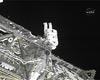 Houston TX (SPX) Mar 10, 2009
Aboard the orbiting International Space Station Monday, the Expedition 18 crew had a bit of down time. After Sunday's suited fit check of their Orlan spacesuits, Commander Mike Fincke and Flight Engineer Yury Lonchakov relaxed Monday in advance of their spacewalk slated to begin at 12:20 p.m. EDT Tuesday. Lonchakov, the lead spacewalker or EV 1, will wear the Orlan suit with the blue stripes. |
|
|

| The content herein, unless otherwise known to be public domain, are Copyright 1995-2007 - SpaceDaily.AFP and UPI Wire Stories are copyright Agence France-Presse and United Press International. ESA Portal Reports are copyright European Space Agency. All NASA sourced material is public domain. Additional copyrights may apply in whole or part to other bona fide parties. Advertising does not imply endorsement,agreement or approval of any opinions, statements or information provided by SpaceDaily on any Web page published or hosted by SpaceDaily. Privacy Statement |
 del.icio.us
 Digg
Digg Reddit
 YahooMyWeb
 Google
 Facebook