|
 |
 |
 |
 |
 |
 |
 |
 |

 |
'Space' kangaroo shines light on global warming
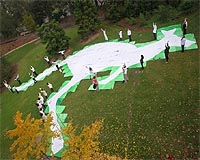
Melbourne (AFP) May 20, 2008 A giant white kangaroo bounced into the science books on Tuesday as part of a global experiment to measure the amount of light the earth reflects back to the sun. The cardboard cut-out marsupial, which measures 32 metres (105 feet) by 18 metres, was laid out in a paddock on the grounds of Monash University in the southern city of Melbourne. "We call it our kangaroo from space because two satellites flew over (and) what they were doing was measuring the amount of light reflected from our kangaroo," Professor Patricia Vickers-Rich told AFP. "And the point of that was to make people aware that reflected light, or lack of reflected light, has a very big effect on climate." Scientists are concerned that the melting of the polar ice caps, happening at a faster rate than expected, is quickly robbing the earth of some of the vast white spaces which have traditionally reflected the sun's rays, she said. "If something is white it reflects a lot of light, if something is dark it absorbs it, and that will affect the temperature of our atmosphere," Vickers-Rich said. "If we reflect less of the sun's energy and we absorb it, then our temperatures will rise. And they are rising, there's no doubt about it." Vickers-Rich said the white kangaroo experiment was one of 20 such tests conducted around the world by US space agency NASA to highlight changes in the amount of light reflected by the earth over the past year. The academic, a geologist and founding director of the Monash Science Centre, said the Melbourne group was the first to make their white reflector into an animal. "We were supposed to put out a square... and we thought, 'Well, why don't we do an animal?" A giant koala and a massive lizard were discussed before it was decided that "everybody recognises the kangaroo." Community Email This Article Comment On This Article Related Links Climate Science News - Modeling, Mitigation Adaptation
 Studies Unveil Greenhouse Processes Back 800000 Years
 Corvallis OR (SPX) May 19, 2008
The newest analysis of trace gases trapped in Antarctic ice cores now provide a reasonable view of greenhouse gas concentrations as much as 800,000 years into the past, and are further confirming the link between greenhouse gas levels and global warming, scientists reported in the journal Nature. |
|
|
| The content herein, unless otherwise known to be public domain, are Copyright Space.TV Corporation. AFP and UPI Wire Stories are copyright Agence France-Presse and United Press International. ESA Portal Reports are copyright European Space Agency. All NASA sourced material is public domain. Additional copyrights may apply in whole or part to other bona fide parties. Advertising does not imply endorsement, agreement or approval of any opinions, statements or information provided by Space.TV Corp on any Web page published or hosted by Space.TV Corp. Privacy Statement |