
 |
 |
 |
 |
 |
 |
 |
 |
 |

 |

Science@NASA Huntsville AL (SPX) Jul 28, 2010 Researchers using NASA's fleet of five THEMIS spacecraft have discovered a form of space weather that packs the punch of an earthquake and plays a key role in sparking bright Northern Lights. They call it "the spacequake." A spacequake is a temblor in Earth's magnetic field. It is felt most strongly in Earth orbit, but is not exclusive to space. The effects can reach all the way down to the surface of Earth itself. "Magnetic reverberations have been detected at ground stations all around the globe, much like seismic detectors measure a large earthquake," says THEMIS principal investigator Vassilis Angelopoulos of UCLA. It's an apt analogy because "the total energy in a spacequake can rival that of a magnitude 5 or 6 earthquake," according to Evgeny Panov of the Space Research Institute in Austria. Panov is first author of a paper reporting the results in the April 2010 issue of Geophysical Research Letters (GRL). In 2007, THEMIS discovered the precursors of spacequakes. The action begins in Earth's magnetic tail, which is stretched out like a windsock by the million mph solar wind. Sometimes the tail can become so stretched and tension-filled, it snaps back like an over-torqued rubber band. Solar wind plasma trapped in the tail hurtles toward Earth. On more than one occasion, the five THEMIS spacecraft were in the line of fire when these "plasma jets" swept by. Clearly, the jets were going to hit Earth. But what would happen then? The fleet moved closer to the planet to find out. "Now we know," says THEMIS project scientist David Sibeck of the Goddard Space Flight Center. "Plasma jets trigger spacequakes." According to THEMIS, the jets crash into the geomagnetic field some 30,000 km above Earth's equator. The impact sets off a rebounding process, in which the incoming plasma actually bounces up and down on the reverberating magnetic field. Researchers call it "repetitive flow rebuffing." It's akin to a tennis ball bouncing up and down on a carpeted floor. The first bounce is a big one, followed by bounces of decreasing amplitude as energy is dissipated in the carpet. "We've long suspected that something like this was happening," says Sibeck. "By observing the process in situ, however, THEMIS has discovered something new and surprising." The surprise is plasma vortices, huge whirls of magnetized gas as wide as Earth itself, spinning on the verge of the quaking magnetic field. "When plasma jets hit the inner magnetosphere, vortices with opposite sense of rotation appear and reappear on either side of the plasma jet," explains Rumi Nakamura of the Space Research Institute in Austria, a co-author of the study. "We believe the vortices can generate substantial electrical currents in the near-Earth environment." Acting together, vortices and spacequakes could have a noticeable effect on Earth. The tails of vortices may funnel particles into Earth's atmosphere, sparking auroras and making waves of ionization that disturb radio communications and GPS. By tugging on surface magnetic fields, spacequakes generate currents in the very ground we walk on. Ground current surges can have profound consequences, in extreme cases bringing down power grids over a wide area. After THEMIS discovered the jets and quakes, Joachim Birn of the Los Alamos National Lab in New Mexico conducted a computer simulation of the rebounding process. Lo and behold, vortices appeared in good accord with THEMIS measurements. Moreover, the simulations suggest that the rebounding process can be seen from Earth's surface in the form of ripples and whirls in auroral displays. Ground stations report just such a phenomenon. "It's a complicated process, but it all fits together," says Sibeck. The work isn't finished. "We still have a lot to learn," he adds. "How big can spacequakes become? How many vortices can swirl around Earth at once--and how do they interact with one another?" Stay tuned for answers from THEMIS.
Share This Article With Planet Earth
Related Links THEMIS The Physics of Time and Space

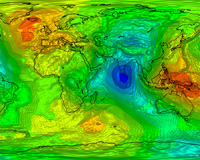 GOCE Helping Reveal The Gravity Of Earth
Paris, France (ESA) Jun 30, 2010 The first global gravity model based on GOCE satellite data has been presented at ESA's Living Planet Symposium. ESA launched GOCE in March 2009 to map Earth's gravity with unprecedented accuracy and resolution. The model, based on only two months of data, from November and December 2009, shows the excellent capability of the satellite to map tiny variations in Earth's gravity. "GOCE is d ... read more |
|
|
| The content herein, unless otherwise known to be public domain, are Copyright 1995-2010 - SpaceDaily. AFP and UPI Wire Stories are copyright Agence France-Presse and United Press International. ESA Portal Reports are copyright European Space Agency. All NASA sourced material is public domain. Additional copyrights may apply in whole or part to other bona fide parties. Advertising does not imply endorsement,agreement or approval of any opinions, statements or information provided by SpaceDaily on any Web page published or hosted by SpaceDaily. Privacy Statement |


 del.icio.us
 Digg
Digg Reddit
 YahooMyWeb
 Google
 Facebook


